




One claim can close a restaurant. Don't let that be yours.
Arkansas restaurants face mandatory workers' comp under Arkansas Code § 11-9-101 at three or more employees, dram shop liability under Arkansas Code § 3-3-210, and tornado exposure — Arkansas ranks among the top ten states for tornado frequency. Insurance Kitchen builds coverage programs exclusively for food-service operations, with most restaurants getting coverage options within 24 to 48 hours.
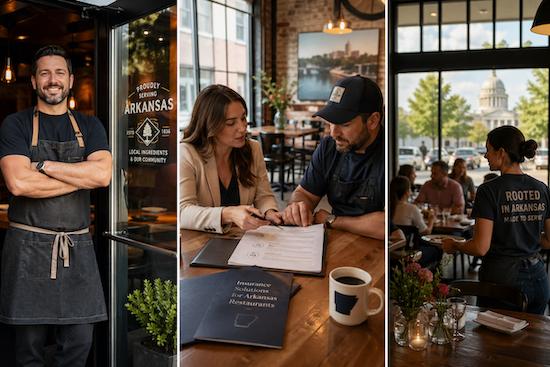
What does your Arkansas restaurant actually need protection against?
Answer a few questions and we'll show you which coverage lines typically matter most for your Arkansas operation — no quote form required to see it.
Coverage Finder
Select every option that applies to your business
Coverage lines that address Arkansas's specific exposures
Arkansas's tornado corridor, dram shop statute, and growing Northwest Arkansas labor market create a specific set of exposures — the coverage lines below address each one directly.
General Liability Insurance
Covers bodily injury and property damage claims from daily operations: customer slip-and-falls, foodborne illness allegations, and third-party property damage. Most Arkansas commercial landlords and shopping center leases require minimum GL limits before occupancy.
Commercial Property Insurance
Protects your building, equipment, and inventory against fire, theft, and weather events. Arkansas restaurants in river-adjacent markets — Little Rock, Fort Smith, and the Delta — face flood exposure from the Arkansas and Mississippi Rivers that requires separate NFIP coverage.
Workers' Compensation Insurance
Arkansas Code § 11-9-101 mandates coverage for restaurants with three or more employees. Kitchen environments carry persistent injury exposure: burns, lacerations, slip-and-fall incidents, and heat illness.
Liquor Liability Insurance
Arkansas Code § 3-3-210 holds licensees civilly liable for serving alcohol to a visibly intoxicated person or a minor who causes injury. The Arkansas ABC Division requires adequate coverage as a licensing condition.
Business Interruption Insurance
A tornado, fire, or flood event that forces closure can eliminate weeks or months of revenue. For seasonal tourism markets like Hot Springs and Eureka Springs, a closure during peak season is disproportionately damaging.
Employment Practices Liability (EPLI)
Arkansas's competitive labor market — particularly the growing Bentonville, Fayetteville, and Rogers corridor — creates elevated EPLI exposure from hiring disputes, wrongful termination claims, and wage-and-hour allegations.
Why Arkansas's weather and growth markets change what your policy needs to do
This isn't generic small-business risk — Arkansas's tornado corridor and Northwest Arkansas growth create exposures that only apply here.
Arkansas's tornado corridor demands confirmed windstorm terms, not assumed coverage
Arkansas ranks among the top ten states for tornado frequency, with the River Valley, central Arkansas, and the Delta experiencing regular severe weather events. Deductibles are often structured as a percentage of insured value rather than a flat dollar amount, and business interruption provisions vary significantly by carrier — terms that must be confirmed at binding, not discovered at claim.
Northwest Arkansas's growth market compounds EPLI and workers' comp exposure at once
The Bentonville, Fayetteville, and Rogers corridor — anchored by Walmart's global headquarters, Crystal Bridges Museum, and University of Arkansas enrollment — is one of the fastest-growing restaurant markets in the South. Rapid growth and competitive hiring increase EPLI and workers' comp exposure simultaneously as restaurants scale staffing quickly.
What might Arkansas restaurant coverage cost you?
A rough range based on your setup — not a quote, just a starting point before you talk to an agent.
How Arkansas's tornado risk actually plays out
A tornado-season closure is a scenario Arkansas operators face on a recurring basis — here's how it typically unfolds.
A tornado in the River Valley damages your dining room and cuts power for several days.
- The damage: Wind damage to the structure triggers a commercial property claim — assuming windstorm deductible structure and sub-limits were confirmed at binding rather than assumed.
- The outage: An extended outage spoils walk-in and reach-in refrigeration contents before replacement product can be sourced — a separate food contamination and spoilage claim.
- The closure: Repairs and cleanup force a temporary closure, and for a Hot Springs or Eureka Springs operator, a closure during peak tourism season is disproportionately damaging to annual revenue.
- The coordinated response: Property, spoilage, and business interruption claims get handled together, rather than falling into gaps between separately purchased policies with inconsistent windstorm terms.
This is exactly why Arkansas's tornado corridor needs confirmed windstorm terms and business interruption limits set before a storm, not after a claim is filed.
Frequently asked questions
Is restaurant insurance required in Arkansas?
Workers compensation is mandatory for Arkansas restaurants with three or more employees under Arkansas Code § 11-9-101. General liability and liquor liability are typically required by commercial landlords and the Arkansas Alcoholic Beverage Control Division as conditions of lease and licensing.
Does Arkansas have a dram shop law?
Yes. Arkansas Code § 3-3-210 establishes civil liability for licensees who serve alcohol to a visibly intoxicated person or a minor. Any Arkansas restaurant or bar serving alcohol should carry standalone liquor liability insurance to cover claims that general liability policies exclude.
Do Arkansas restaurants need tornado or windstorm insurance?
Arkansas sits in a high-frequency tornado corridor. Standard commercial property policies may include windstorm coverage, but deductibles and sub-limits vary widely. Restaurants in the River Valley, central Arkansas, and the Delta should confirm windstorm coverage terms and business interruption provisions before tornado season.
What is the workers' comp threshold for Arkansas restaurants?
Arkansas Code § 11-9-101 requires workers compensation for businesses with three or more employees. Coverage must be in place before the third employee begins work. Kitchen injuries, slip-and-fall incidents, and heat illness are the primary workers' comp loss drivers in food service.
Why does Northwest Arkansas need specialized restaurant insurance?
The Fayetteville, Bentonville, and Rogers corridor has experienced significant restaurant growth driven by Walmart's global headquarters, Crystal Bridges Museum, and University of Arkansas enrollment. High-volume locations, corporate catering contracts, and event-driven revenue spikes create layered liability exposure that standard small-business policies are not built to cover.
What does Insurance Kitchen provide for Arkansas restaurant owners?
Insurance Kitchen builds restaurant-specific coverage programs for Arkansas operators, from Little Rock's River Market District and the Northwest Arkansas culinary corridor to Hot Springs tourism dining and Fort Smith independent restaurants. Every program addresses Arkansas's specific risk profile: tornado exposure, dram shop statute, workers' comp thresholds, and flood risk in river-adjacent markets.
Arkansas Cities We Serve
Neighborhood-specific restaurant insurance guidance for Arkansas's largest restaurant markets, real local risk, not a statewide template.
Little Rock Restaurant Insurance
Neighborhood-level coverage guidance built specifically for Little Rock restaurant owners.
Bentonville Restaurant Insurance
Neighborhood-level coverage guidance built specifically for Bentonville restaurant owners.
Hot Springs Restaurant Insurance
Neighborhood-level coverage guidance built specifically for Hot Springs restaurant owners.
Fort Smith Restaurant Insurance
Neighborhood-level coverage guidance built specifically for Fort Smith restaurant owners.
Get your Arkansas restaurant covered today.
Tell us about your restaurant and we'll find the right coverage at the right price — no pressure, no obligation.
Get Your Free Quote →