




Restaurant Insurance in Fort Smith, Arkansas
If you're a Fort Smith restaurant owner searching for insurance that actually understands the real tornado history that once killed dozens in a single night, a documented 2019 flood that made parts of the city accessible only by boat, and a restaurant operating inside an 1887 Victorian mansion, Insurance Kitchen builds coverage around that reality. The January 1898 tornado killed 55 to 56 people, one of the deadliest in U.S. history. We build Fort Smith restaurant coverage around your actual building and real local risk.
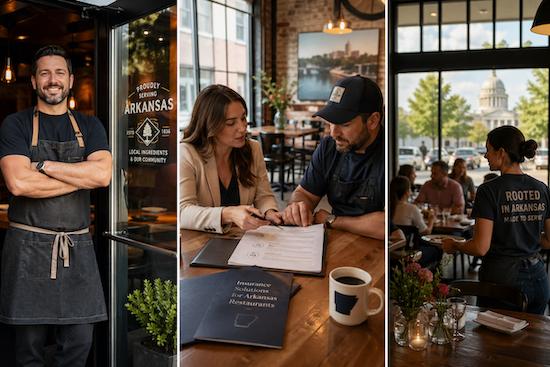
We know Fort Smith's restaurant scene block by block
Fort Smith's restaurant scene runs from a rebuilt post-tornado commercial spine to a riverfront district shaped by a real 1830s frontier fort, with a documented tornado and flood history to plan around. Here's what we watch for across its districts.
West Garrison Avenue Historic District
Listed on the National Register on April 26, 1979 with a boundary increase in 2001, covering more than 175 buildings dating to Fort Smith's 1838 founding. The April 21, 1996 F3 tornado destroyed 13 historic structures along this exact stretch, real, dated precedent for historic-commercial-building risk in the district restaurants operate in today.
Fort Smith National Historic Site
Preserves 1817-1896 history including Judge Isaac C. Parker, the "Hanging Judge," who presided over the Western District of Arkansas federal court from 1875 to 1896. A real, NPS-documented anchor landmark drawing foot traffic to the surrounding dining district.
Belle Grove Historic District
Listed on the National Register on July 16, 1973, a 65-acre, 22-block area with development mostly dating 1870-1930 in Late Victorian style. Its age and construction profile directly informs the building stock surrounding downtown dining.
Riverfront District
A real, active dining corridor along the Arkansas River adjacent to the Fort Smith National Historic Site, home to the Riverfront Amphitheater. This is the district most directly exposed to the documented 2019 flood, when parts of the city were accessible only by boat.
Core coverage lines every Fort Smith restaurant should evaluate
Restaurant insurance in Fort Smith is a tailored bundle built around Arkansas law, local licensing, and your lease. Here's what actually protects Fort Smith food service businesses.
General Liability Insurance
Protects against third-party bodily injury and property damage claims. Responds when guests slip, suffer foodborne illness, or get injured during delivery. Most landlords require $1M/$2M before lease signing.
Commercial Property Insurance
Covers your kitchen equipment, refrigeration and HVAC, tenant improvements, inventory, and business personal property against fire, equipment breakdown, and theft.
Business Owner's Policy (BOP)
Bundles general liability, commercial property, and business interruption into one package. Works best for single-unit restaurants with annual revenue under $3 million.
Liquor Liability Insurance
Arkansas Code § 3-3-210 holds licensees civilly liable for serving a visibly intoxicated person or a minor who causes injury.
Workers' Compensation Insurance
Covers medical expenses and lost wages for work-related injuries. Arkansas requires coverage under Ark. Code § 11-9-101 once a restaurant employs 3 or more workers.
Business Interruption Insurance
Replaces lost income and covers ongoing expenses when covered events force shutdowns or reduced capacity. Limits should reflect 3 to 6 months of net income plus fixed expenses.
What restaurant insurance typically costs in Fort Smith
A rough range based on real Arkansas market data. Not a quote, just a starting point before you talk to an agent about your specific Fort Smith location.
| Coverage Type | Typical Annual Range | Why It Varies |
|---|---|---|
| General Liability Insurance | $700–$2,000/yr | Scales with your landlord's required limits and your building's age, especially in historic districts like West Garrison Avenue and Belle Grove. |
| Liquor Liability Insurance | $1,200–$4,000/yr | Arkansas Code § 3-3-210 holds licensees civilly liable for serving a visibly intoxicated person or a minor, and downtown's entertainment-district ordinance allowing open containers within a defined boundary adds real, additional exposure. |
| Commercial Property w/ Flood & Windstorm Endorsement | $1,500–$5,000/yr | Standard property policies exclude flood damage; the Arkansas River hit a record 40.79-foot crest at the Van Buren gauge in June 2019, with roughly 500-545 Fort Smith-area homes flood-damaged, and the January 1898 tornado remains one of the deadliest in U.S. history. |
| Workers' Compensation | Payroll-class rated | Mandatory under Ark. Code § 11-9-101 once a Fort Smith restaurant employs 3 or more workers. |
| Business Interruption Insurance | Rated by exposure | Covers lost revenue during tornado, flood, or extended closures tied to Fort Smith's documented severe-weather and river-flood history. |
| Full-Service w/ Liquor License, Bundled | $7,000–$16,000/yr | Restaurants in the riverfront district or historic downtown corridor should budget toward the higher end. |
Why Fort Smith's tornado history and river-flood exposure change what your policy needs to do
Fort Smith restaurant coverage has to account for a real, documented tornado history among the deadliest in U.S. history and genuine Arkansas River flood risk, on top of Arkansas's statewide dram shop and workers' comp framework.
Fort Smith's tornado history is real, severe, and directly tied to today's building stock
The January 11, 1898 F4 tornado killed 55 to 56 people and injured well over 100, with damage exceeding $453,000 in 1898 dollars, per documented history of the tornado, one of the deadliest in U.S. history. A second F3 tornado on April 21, 1996 destroyed 13 historic structures along West Garrison Avenue and caused more than $300 million in damage, real, dated precedent for the exact commercial district restaurants occupy today.
The 2019 flood is a real, documented benchmark for river-corridor risk
The Arkansas River hit a record crest of 40.79 feet at the Van Buren gauge directly across from Fort Smith on June 1, 2019, per NOAA's own gauge records, which call it the flood of record. As many as 200 people evacuated in Fort Smith, and parts of the city were accessible only by boat. Standard commercial property policies exclude flood damage entirely.
A spring tornado threatens your West Garrison Avenue restaurant housed in a historic downtown building.
A closer look at how Fort Smith's real, documented risk factors actually play out.
A spring tornado threatens your West Garrison Avenue restaurant housed in a historic downtown building.
- The history: A 1996 F3 tornado destroyed 13 historic structures along this exact stretch of West Garrison Avenue, real, dated proof this district has faced this kind of damage before.
- The damage: Wind damage to a century-old commercial building triggers a claim, standard property coverage needs windstorm terms confirmed against a building this old, not assumed.
- The closure: Repairs and cleanup force a temporary closure, business interruption coverage sized to your real revenue, not a flat annual average, replaces the lost income.
- The result: Coverage that reflects Fort Smith's real, documented tornado history and its historic downtown building stock.
This is exactly why Fort Smith-specific coverage matters. A generic Arkansas policy doesn't automatically account for a tornado history this severe or a building stock this old.
Frequently asked questions
How bad was Fort Smith's 1898 tornado?
Among the deadliest in U.S. history. The January 11, 1898 F4 tornado struck Fort Smith at night, killing 55 to 56 people and injuring well over 100, with damage exceeding $453,000 in 1898 dollars.
Did a tornado really damage Fort Smith's historic downtown?
Yes. An F3 tornado on April 21, 1996 devastated the downtown business district, destroying 13 historic structures along West Garrison Avenue and causing more than $300 million in damage across Fort Smith and Van Buren.
How bad was Fort Smith's 2019 flood?
Serious enough to make parts of the city accessible only by boat. The Arkansas River hit a record crest of 40.79 feet at the nearby Van Buren gauge on June 1, 2019, NOAA calls it the flood of record, and as many as 200 people evacuated in Fort Smith.
Do Fort Smith's Garrison Avenue historic buildings cost more to insure?
Often, yes. Historic storefronts in Fort Smith's Garrison Avenue historic district can face higher commercial property premiums unless the building's electrical and plumbing systems have been fully modernized, since insurers price older, unretrofitted systems as a higher fire and water-damage risk than a comparable building with updated infrastructure. That's a separate cost factor from the tornado and flood risk already affecting Fort Smith broadly, worth budgeting for on its own if your restaurant occupies one of the district's older buildings.
Does Fort Smith have any outdoor-dining or open-container rules?
Yes. Fort Smith adopted an entertainment-district ordinance allowing patrons to carry open alcohol containers outside bars and restaurants within a defined downtown boundary during designated hours, layered on top of Arkansas's statewide dram shop law.
Get Fort Smith restaurant coverage built around your actual neighborhood and real local risk.
Tell us your concept and your Fort Smith neighborhood. We'll put together the coverage that actually applies.
Get Your Free Quote →