




Restaurant Insurance in Hot Springs, Arkansas
If you're a Hot Springs restaurant owner searching for insurance that actually understands the real scale of a tourist economy built around the oldest federally protected land in the National Park System, a genuinely documented organized-crime history that shaped downtown's building stock, and a restaurant with a Bill Clinton connection dating to 1928, Insurance Kitchen builds coverage around that reality. Hot Springs draws an estimated 9.8 million visitors a year to a city of under 38,000 residents. We build Hot Springs restaurant coverage around your actual season and real local risk.
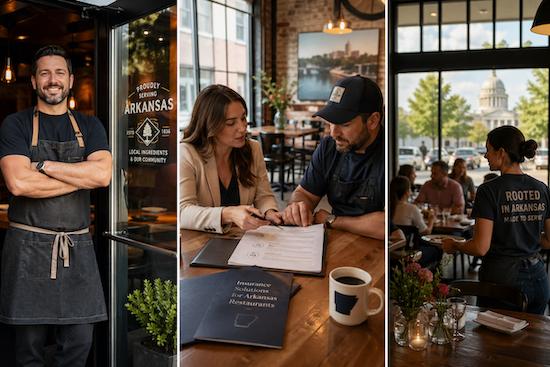
We know Hot Springs's restaurant scene block by block
Hot Springs' restaurant scene runs from a National Historic Landmark bathhouse district built on a genuine mid-century gambling economy to a man-made lake ringed with waterfront dining, with a real, extreme tourist-season concentration to plan around. Here's what we watch for across its districts.
Bathhouse Row / Central Avenue
Designated a National Historic Landmark District on May 28, 1987. Superior Bathhouse Brewery, inside the former Superior Bathhouse, is documented as the only brewery in the world located inside a U.S. National Park and the only one brewing with thermal spring water, a genuinely unique, National Park Service-managed utility dependency relevant to property and business-interruption risk.
Central Avenue Historic District
A 77-property historic district anchored by the 1924 Arlington Hotel and 1929 Art Deco Medical Arts Building, built on the prosperity of Hot Springs' real, documented illegal-casino economy that ran from the late 1800s until 1967. The Ohio Club, founded 1905, is marketed today as Arkansas's oldest operating bar, a direct restaurant-industry legacy of that era.
Lake Hamilton
A reservoir created in the 1930s by Carpenter Dam, today lined with resorts, homes, and waterfront restaurants, a distinct dock and marine-liability exposure profile from downtown's historic building stock.
Core coverage lines every Hot Springs restaurant should evaluate
Restaurant insurance in Hot Springs is a tailored bundle built around Arkansas law, local licensing, and your lease. Here's what actually protects Hot Springs food service businesses.
General Liability Insurance
Protects against third-party bodily injury and property damage claims. Responds when guests slip, suffer foodborne illness, or get injured during delivery. Most landlords require $1M/$2M before lease signing.
Commercial Property Insurance
Covers your kitchen equipment, refrigeration and HVAC, tenant improvements, inventory, and business personal property against fire, equipment breakdown, and theft.
Business Owner's Policy (BOP)
Bundles general liability, commercial property, and business interruption into one package. Works best for single-unit restaurants with annual revenue under $3 million.
Liquor Liability Insurance
Arkansas Code § 3-3-210 holds licensees civilly liable for serving a visibly intoxicated person or a minor who causes injury.
Workers' Compensation Insurance
Covers medical expenses and lost wages for work-related injuries. Arkansas requires coverage under Ark. Code § 11-9-101 once a restaurant employs 3 or more workers.
Business Interruption Insurance
Replaces lost income and covers ongoing expenses when covered events force shutdowns or reduced capacity. Limits should reflect 3 to 6 months of net income plus fixed expenses.
What restaurant insurance typically costs in Hot Springs
A rough range based on real Arkansas market data. Not a quote, just a starting point before you talk to an agent about your specific Hot Springs location.
| Coverage Type | Typical Annual Range | Why It Varies |
|---|---|---|
| General Liability Insurance | $700–$2,000/yr | Scales with your lease terms and building age, especially in the historic Central Avenue commercial district. |
| Liquor Liability Insurance | $1,200–$4,000/yr | Arkansas Code § 3-3-210 holds licensees civilly liable for serving a visibly intoxicated person or a minor, real exposure for Hot Springs' tourism-driven bar and restaurant scene. |
| Commercial Property Insurance | $1,500–$5,000/yr | Historic Bathhouse Row properties draw on a National Park Service-managed thermal water utility system rather than a standard municipal line, a real, non-template infrastructure dependency worth confirming coverage against. |
| Workers' Compensation | Payroll-class rated, seasonal-staffing sensitive | Mandatory under Ark. Code § 11-9-101 at 3 or more employees; Hot Springs' roughly 258-to-1 visitor-to-resident ratio creates real, concentrated seasonal-staffing demand. |
| Business Interruption Insurance | Rated by exposure, sized to peak season | Covers lost revenue tied to Hot Springs' real, extreme tourist-season concentration, an estimated 9.8 million annual visitors against under 38,000 residents. |
| Full-Service w/ Liquor License, Bundled | $7,000–$16,000/yr | Restaurants in the historic Bathhouse Row district or on Lake Hamilton's waterfront should budget toward the higher end. |
Why Hot Springs' tourist-season scale and historic infrastructure change what your policy needs to do
Hot Springs restaurant coverage has to account for a real, extreme tourist-season concentration and genuinely unique historic infrastructure, on top of Arkansas's statewide dram shop and workers' comp framework.
Hot Springs' tourist economy is real and extreme relative to its population
Hot Springs draws an estimated 9.8 million visitors annually, 75% from out of state, generating roughly $1 billion in economic impact, per the city's own Convention & Visitors Bureau reporting, against a resident population of just 37,930 per the 2020 Census. Business interruption coverage sized to a flat annual average misses this real, extreme concentration.
Hot Springs National Park's own infrastructure history is a real, checkable property fact
Set aside as a federal reservation on April 20, 1832, per the National Park Service's own history, Hot Springs predates Yellowstone by 40 years as the oldest area in today's National Park System. A centralized thermal-water distribution system built in 1933 still delivers water to Bathhouse Row buildings today, a genuinely unusual utility dependency for any restaurant or brewery operating there.
Your Hot Springs restaurant staffs up for peak tourist season, from a quiet winter week to a packed summer weekend.
A closer look at how Hot Springs's real, documented risk factors actually play out.
Your Hot Springs restaurant staffs up for peak tourist season, from a quiet winter week to a packed summer weekend.
- The surge: Hot Springs draws an estimated 9.8 million visitors a year against a resident population of under 38,000, real, documented seasonal demand concentration most cities never see.
- The infrastructure: If your restaurant or brewery sits on Bathhouse Row, it draws water from a National Park Service-managed thermal system built in 1933, not a standard municipal line, a real, specific dependency worth confirming coverage against.
- The gap: A flat, year-round liability and staffing estimate doesn't reflect the real payroll and foot-traffic swing between a quiet winter week and peak season.
- The fix: Your coverage is reviewed against your actual peak-season staffing plan and your building's real infrastructure dependencies, not a flat annual assumption.
This is exactly why Hot Springs-specific coverage matters. A generic Arkansas policy doesn't automatically account for tourist demand this concentrated or infrastructure this unique.
Frequently asked questions
How many tourists does Hot Springs really draw compared to its population?
A lot. Hot Springs draws an estimated 9.8 million visitors a year, 75% from out of state, generating roughly $1 billion in economic impact, against a resident population of just 37,930 per the 2020 Census, a ratio of roughly 258 visitors for every resident.
Is Hot Springs' organized-crime history actually real, or just local legend?
It's real and well-documented. Hot Springs ran wide-open illegal casino gambling from the late 1800s until 1967, and mobster Owney Madden relocated there in 1935, living in the city until his death in 1965. This history directly shaped the Central Avenue commercial district's historic building stock.
Should Hot Springs restaurants carry Employment Practices Liability coverage?
It's worth considering. Employment Practices Liability Insurance (EPLI), typically $50 to $150 per month, protects against wrongful termination, discrimination, or harassment claims, a real exposure for any restaurant managing seasonal hiring swings around Hot Springs' heavy tourist season. Unlike general liability, which covers customer-facing claims, EPLI specifically covers employee-brought claims, a gap a standard restaurant policy doesn't automatically fill.
Does Hot Springs' severe weather affect restaurant property insurance costs?
Yes. Arkansas is prone to severe thunderstorms, tornadoes, and flash floods, and Hot Springs restaurants are no exception, so commercial property premiums here factor in both the age of your building and whether you've installed commercial-grade fire suppression and storm-proofing systems. An older building without those upgrades will typically see a higher property premium than a comparable, newer or retrofitted building, a real cost lever worth addressing before a claim rather than after one.
Does Arkansas's dram shop law apply differently in Hot Springs?
The same statewide standard applies. Arkansas Code § 3-3-210 holds licensees civilly liable for serving a visibly intoxicated person or a minor who causes injury.
Get Hot Springs restaurant coverage built around your actual neighborhood and real local risk.
Tell us your concept and your Hot Springs neighborhood. We'll put together the coverage that actually applies.
Get Your Free Quote →