




One claim can close a West Virginia restaurant. Don't let that be yours.
West Virginia is the only state where mine subsidence insurance is legally required inside every commercial property policy unless waived in writing — the state-backed fund provides reinsurance up to $200,000 per structure. The June 2016 floods killed 23 people and devastated Greenbrier County, and standard commercial property policies covered none of that flood damage. Layer on a dram shop framework built on three 1990 Supreme Court cases with no statutory damages cap, and West Virginia's risk profile is genuinely distinct from its neighbors.
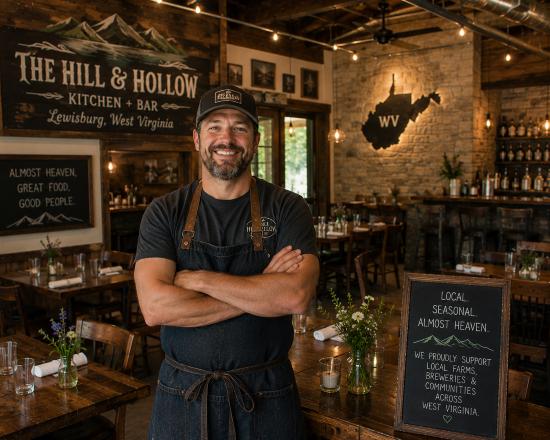
What does your West Virginia restaurant actually need protection against?
Answer a few questions and we'll show you which coverage lines typically matter most for your West Virginia operation — no quote form required to see it.
Coverage Finder
Select every option that applies to your business
Coverage lines that address West Virginia's specific exposures
West Virginia's mine subsidence mandate, its judge-made dram shop framework, and its recurring catastrophic flood risk create a specific set of exposures standard commercial policies aren't built to handle.
General Liability Insurance
Covers slip-and-fall, customer injury, and food contamination claims. Adventure tourism restaurants near New River Gorge and Snowshoe Mountain face elevated premises liability from high-energy customers who arrive tired or sun-exposed and then consume alcohol.
Commercial Property Insurance
WV Code § 33-30 requires mine subsidence coverage in every property policy insuring a West Virginia structure. It's already on your policy unless you waived it in writing — confirm the limit reflects your actual replacement cost, not a nominal default.
Liquor Liability Insurance
West Virginia's dram shop liability comes from three 1990 Supreme Court cases (Bailey v. Black, Anderson v. Moulder, Overbaugh v. McCutcheon) reading WV Code §§ 60-7-12 and 55-7-9 together, with no statutory damages cap on the resulting judgments.
Workers' Compensation Insurance
West Virginia moved from a state monopoly to a fully competitive NCCI market in 2008. Base loss costs fell more than 78 percent since 2006, and Class Code 9082 now averages approximately $1.06 per $100 of payroll — well below the national average.
Flood Insurance
The June 2016 floods killed 23 people and destroyed hundreds of structures in Greenbrier County alone. Only 1.2 percent of West Virginia residential structures carry an NFIP policy — commercial coverage rates are even lower, and the gap is enormous.
Employment Practices Liability (EPLI)
West Virginia's 80/20 rule requires full minimum wage when a tipped employee's non-tipped side work exceeds 20 percent of a workweek, and tracking that ratio per employee is a standing compliance requirement.
Why West Virginia's mine subsidence law and flood history change what your policy needs to do
This isn't generic small-business risk — West Virginia's specific statutory structure and disaster history create exposures that only apply here.
Mine subsidence coverage is on your policy right now — verify you didn't waive it
Under WV Code § 33-30, mine subsidence coverage is automatically included in every commercial property policy covering a West Virginia structure at a separately stated premium, with the only exception being a written waiver at policy issuance. In coal counties including McDowell, Wyoming, Logan, Mingo, Boone, Raleigh, and Fayette, waiving it is inadvisable — abandoned underground mines create documented ground movement and foundation damage risk.
West Virginia's flood risk is chronically underinsured, not chronically overstated
The June 2016 floods killed 23 people and produced the largest recent property loss event in modern West Virginia history, yet only 1.2 percent of the state's residential structures carry an NFIP policy. Standard commercial property policies exclude flood entirely regardless of FEMA designation, and West Virginia's mountainous terrain and narrow river valleys make flash flooding rapid and severe.
What might West Virginia restaurant coverage cost you?
A rough range based on your setup — not a quote, just a starting point before you talk to an agent.
How a West Virginia flood disaster actually plays out
The June 2016 Greenbrier County flood is the defining loss event for West Virginia restaurants — here's how an uninsured gap unfolds for a similar event today.
A flash flood in a narrow West Virginia river valley inundates your restaurant with minimal warning.
- The exclusion: Standard commercial property policies exclude flood damage entirely, regardless of FEMA flood zone designation — the June 2016 event proved that even communities outside mapped zones can face catastrophic flooding.
- The uninsured majority: Only 1.2 percent of West Virginia residential structures carry an NFIP policy, and commercial restaurant coverage rates are even lower — most operators in this scenario have no flood coverage at all.
- The mine subsidence question: If the same location sits in a coal county, operators should separately confirm mine subsidence coverage is intact and not waived, since flood and subsidence are two distinct, unrelated property gaps.
- The fix: NFIP commercial flood coverage, supplemented by private carriers for higher-value buildings, is the only mechanism that responds to a flood loss — and the 30-day waiting period means it must be in place before the flood, not after.
This is exactly why West Virginia's mountainous terrain and narrow valleys need a policy built around the state's actual flood history — the June 2016 disaster is not a one-time event but a recurring pattern.
Frequently asked questions
What is mine subsidence insurance and why is it on my West Virginia property policy?
Under WV Code § 33-30, every property insurance policy covering a West Virginia structure must automatically include mine subsidence coverage at a separately stated premium, because the state's extensive coal mining history has left underground voids beneath large portions of the state. The state-backed Mine Subsidence Insurance Fund provides reinsurance up to $200,000 per structure. Fifteen counties with minimal mining history are exempt, including Berkeley, Cabell, Jefferson, Morgan, and Wood.
Does West Virginia have a dram shop statute?
Not in the traditional codified sense. West Virginia's dram shop liability was created by the state Supreme Court in 1990 through a trio of cases — Bailey v. Black, Anderson v. Moulder, and Overbaugh v. McCutcheon — by reading WV Code § 60-7-12 (the criminal prohibition on serving visibly intoxicated persons) together with WV Code § 55-7-9 (the negligence per se statute). Licensed vendors who serve visibly intoxicated patrons can be held civilly liable for third-party injuries with no statutory damages cap.
Do I need flood insurance if I'm not in a FEMA flood zone?
Yes. The June 2016 catastrophic floods that killed 23 people and devastated Greenbrier County communities were the defining property loss event in modern West Virginia history. Standard commercial property policies exclude flood damage regardless of FEMA designation. Only 1.2 percent of West Virginia residential structures carry NFIP flood policies — the gap is enormous.
My restaurant is in Mingo County — should I waive mine subsidence coverage?
No. Mingo County has significant underground coal mining history, and mine subsidence coverage is relevant there. The automatic inclusion under WV Code § 33-30 exists precisely because counties like Mingo, McDowell, Logan, and Wyoming have documented ground movement risk from legacy mines. Verify the separately stated premium and limit on your policy reflect your actual building value.
How does West Virginia's tip credit work with the 80/20 side work rule?
West Virginia's tip credit allows a cash wage of $2.62 per hour, provided tips bring total compensation to $8.75 per hour. When a tipped employee spends more than 20 percent of their workweek on non-tipped duties — cleaning, restocking, rolling silverware — the employer must pay the full $8.75 minimum wage for that excess time, with no tip credit. Tracking this per employee per workweek is the compliance requirement, and failure to do so is the most common wage and hour exposure for West Virginia operators.
What is the WV FAIR Plan and when would I need it?
The West Virginia FAIR Plan provides last-resort commercial property coverage up to $500,000 when a business cannot obtain coverage through the standard admitted market, covering fire, lightning, wind, hail, aircraft, vehicles, smoke, and explosion — but not liability. Restaurants facing non-renewals due to flood zone location, prior claims, or property condition may need it while resolving the underlying underwriting issue; the $500,000 limit is often insufficient for full-size buildings, making private surplus lines coverage the alternative.
West Virginia Cities We Serve
Neighborhood-specific restaurant insurance guidance for West Virginia's largest restaurant markets, real local risk, not a statewide template.
Charleston Restaurant Insurance
Neighborhood-level coverage guidance built specifically for Charleston restaurant owners.
White Sulphur Springs Restaurant Insurance
Neighborhood-level coverage guidance built specifically for White Sulphur Springs restaurant owners.
Fayetteville Restaurant Insurance
Neighborhood-level coverage guidance built specifically for Fayetteville restaurant owners.
Wheeling Restaurant Insurance
Neighborhood-level coverage guidance built specifically for Wheeling restaurant owners.
Get your West Virginia restaurant covered today.
Tell us about your restaurant and we'll find the right coverage at the right price — no pressure, no obligation.
Get Your Free Quote →