




Restaurant Insurance in Woodstock, Vermont
If you're a Woodstock restaurant owner searching for insurance that actually understands a flood that knocked out the town's water supply for 10 straight days, a state where restaurants will soon be required to carry liquor liability coverage just to hold a license, and a 150-year-old working dairy farm that anchors the town's food identity, Insurance Kitchen builds coverage around that reality. The July 2023 Vermont floods forced Woodstock's restaurants, hotels, and daycare centers to close outright. We build Woodstock restaurant coverage around your actual neighborhood and local risk.
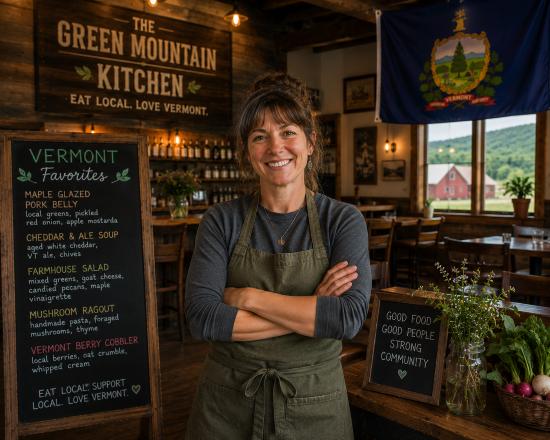
We know Woodstock's restaurant scene block by block
Woodstock's restaurant scene sits inside a 275-acre historic district built around a working dairy farm, with a real, recent water-supply flood event to plan around. Here's what we watch for across its neighborhoods.
Woodstock Village Historic District
Listed on the National Register of Historic Places on January 22, 1973, with a boundary increase in 2021, covering 275 acres and 95 contributing buildings, sites, and structures centered on an elliptical village green. Home to Billings Farm and Museum and the Norman Williams Public Library.
South Woodstock Village Historic District
Listed on the National Register of Historic Places in 1983, covering 360 acres in the Kedron Brook Valley. Once a center of sheep husbandry, with Greek Revival and Federal-era brick architecture predating the Civil War.
Core coverage lines every Woodstock restaurant should evaluate
Restaurant insurance in Woodstock is a tailored bundle built around Vermont law, local licensing, and your lease. Here's what actually protects Woodstock food service businesses.
General Liability Insurance
Protects against third-party bodily injury and property damage claims. Responds when guests slip, suffer foodborne illness, or get injured during delivery. Most landlords require $1M/$2M before lease signing.
Commercial Property Insurance
Covers your kitchen equipment, refrigeration and HVAC, tenant improvements, inventory, and business personal property against fire, equipment breakdown, and theft.
Business Owner's Policy (BOP)
Bundles general liability, commercial property, and business interruption into one package. Works best for single-unit restaurants with annual revenue under $3 million.
Liquor Liability Insurance
7 V.S.A. § 501 holds a licensee liable for negligently serving a minor or a visibly intoxicated patron, punitive damages are available per Clymer v. Webster (1991), and a new requirement effective July 1, 2026 makes minimum liquor liability coverage a condition of holding a Vermont liquor license at all.
Workers' Compensation Insurance
Covers medical expenses and lost wages for work-related injuries. 21 V.S.A. § 616 applies coverage to all employment with no headcount exemption, though up to four corporate officers or LLC managers may formally elect out with state approval.
Business Interruption Insurance
Replaces lost income and covers ongoing expenses when covered events force shutdowns or reduced capacity. Limits should reflect 3 to 6 months of net income plus fixed expenses.
What restaurant insurance typically costs in Woodstock
A rough range based on real Vermont market data. Not a quote, just a starting point before you talk to an agent about your specific Woodstock location.
| Coverage | Typical Range | Why |
|---|---|---|
| General Liability Insurance | $550–$2,600/yr | Scales with your landlord's required limits and your building's age, especially inside the historic village-green core. |
| Liquor Liability Insurance | $400–$2,200/yr | 7 V.S.A. § 501 already creates real civil exposure for negligently serving a minor or intoxicated patron, and starting July 1, 2026, Vermont will require minimum liquor liability coverage as a condition of the license itself. |
| Commercial Property w/ Water-Supply & Flood Endorsement | $1,800–$5,600/yr | The July 2023 flood knocked out Woodstock's public water supply for 10 days, forcing restaurants, hotels, and daycare centers to close outright, a real reason business interruption coverage needs to account for utility failure, not just physical damage. |
| Workers' Compensation | $0.35–$1.60 per $100 of payroll | Vermont's coverage requirement doesn't ease up for a small, historic-district restaurant: it applies from your very first employee just like anywhere else in the state. |
| Business Owner's Policy (BOP), Bundled | $1,400–$4,200/yr | Bundles general liability and commercial property at a discounted rate, the standard starting point for most single-unit Woodstock restaurants. |
| Full-Service, Bundled | $4,000–$9,800/yr | Restaurants in older village-green buildings, or those running a full bar, should budget toward the higher end. |
Why the 2023 water-supply flood and Vermont's new liquor liability rule change what your policy needs to do
Woodstock restaurant coverage has to account for a documented flood that shut down the town's water supply itself, not just individual buildings, on top of Vermont's evolving liquor liability framework, which is about to add a mandatory coverage requirement on top of existing civil exposure.
The July 2023 flood knocked out the water supply that restaurants depend on
The July 2023 Vermont floods knocked out Woodstock's public water supply for 10 days, which forced daycare centers, hotels, and restaurants to close, and the Woodstock Farmers' Market, inundated by floodwaters, didn't reopen until September 8, 2023, per Wikipedia's documented account of the event. A restaurant can lose its entire ability to operate from a utility-level failure like this even if the building itself takes no direct damage, which is why confirming your business interruption coverage responds to utility and water-supply outages, not just physical property loss, matters here specifically.
Vermont is adding a mandatory liquor liability insurance requirement on top of existing civil exposure
7 V.S.A. § 501 already holds a licensee liable for negligently serving a minor or a visibly intoxicated patron, and the Vermont Supreme Court confirmed in Clymer v. Webster (1991) that punitive damages are available under the Dram Shop Act. A newer provision, effective July 1, 2026, requires the Department of Liquor and Lottery to adopt minimum liquor liability insurance requirements as a condition of issuing or renewing a license at all, a real, upcoming compliance point for any Woodstock restaurant serving alcohol.
Heavy rain floods the Ottauquechee River corridor and knocks out Woodstock's public water supply near your restaurant.
A closer look at how Woodstock's documented risk factors actually play out.
Heavy rain floods the Ottauquechee River corridor and knocks out Woodstock's public water supply near your restaurant.
- The history: The July 2023 flood knocked out Woodstock's public water supply for 10 full days, forcing restaurants, hotels, and daycare centers to close regardless of whether their own building flooded.
- The market closure: The Woodstock Farmers' Market didn't reopen until September 8, 2023, nearly two months after the flood, a real example of how long recovery can actually take.
- The coverage question: Confirm your business interruption coverage responds to utility and water-supply outages, not just direct physical damage to your own building.
- The fix: A policy with business interruption coverage matched to a utility-level outage, not just a single-day closure, is what actually responds to an event like July 2023's.
This is exactly why Woodstock-specific coverage matters. A generic statewide policy doesn't automatically account for a water-supply failure documented at this scale.
Frequently asked questions
How much does restaurant insurance cost in Woodstock?
Restaurant insurance in Woodstock typically runs $3,200 to $9,800 per year for a standard package combining general liability, commercial property, and workers' compensation. General liability runs $550 to $2,600 per year; commercial property with a water-supply and flood endorsement runs $1,800 to $5,600 per year; workers' compensation runs roughly $0.35 to $1.60 per $100 of payroll. Liquor liability runs $400 to $2,200 per year.
Can a Woodstock restaurant be held liable for over-serving a customer?
Yes. 7 V.S.A. § 501 holds a licensee liable for negligently serving a minor or a visibly intoxicated patron, and the Vermont Supreme Court confirmed in Clymer v. Webster (1991) that punitive damages are available. Starting July 1, 2026, Vermont will also require minimum liquor liability coverage as a condition of holding the license itself.
Does a public water-supply failure count as a covered loss for a Woodstock restaurant?
Only if your policy is written to cover it. The July 2023 flood knocked out Woodstock's public water supply for 10 days, forcing restaurants, hotels, and daycare centers to close even without direct flood damage to their own buildings. Confirm your business interruption coverage explicitly responds to utility outages, not just physical property damage.
Do restaurants in the Woodstock Village Historic District cost more to insure?
Often, yes. The district's 95 contributing buildings date from the late 18th through late 19th centuries. Insuring a building of that age typically costs more than new construction because of higher replacement costs for period materials and older electrical or plumbing systems.
Is workers' compensation required for a small Woodstock restaurant with only a few employees?
Yes, and being inside a historic district doesn't change it. Vermont's all-employment standard under 21 V.S.A. § 616 applies the same way to a century-old village-green storefront as it would to a brand-new building. Only owners who pass a strict six-part independent-contractor test, or up to four corporate officers who formally elect out, have any path around it.
Get Woodstock restaurant coverage built around your actual neighborhood and real local risk.
Tell us your concept and your Woodstock neighborhood. We'll put together the coverage that actually applies.
Get Your Free Quote →