




Restaurant Insurance in Burlington, Vermont
If you're a Burlington restaurant owner searching for insurance that actually understands a lake that stayed above flood stage for 69 straight days, a state where restaurants will soon be required to carry liquor liability coverage just to hold a license, and a chef who's been a James Beard finalist four times over, Insurance Kitchen builds coverage around that reality. Lake Champlain set an all-time record crest in the spring of 2011. We build Burlington restaurant coverage around your actual neighborhood and local risk.
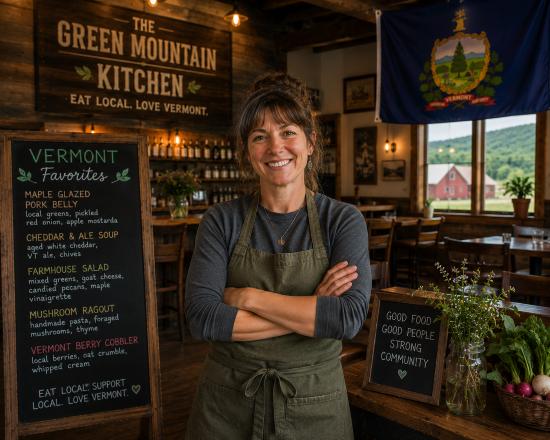
We know Burlington's restaurant scene block by block
Burlington's restaurant scene runs from a pedestrian marketplace of 19th-century storefronts to an immigrant-founded commercial corridor, with a documented lake-flood record to plan around. Here's what we watch for across its neighborhoods.
Church Street Historic District / Marketplace
Listed on the National Register of Historic Places in 2010, covering 86 storefronts of 19th-century commercial architecture across four pedestrian blocks. Named one of America's Great Public Spaces by the American Planning Association in 2008, today home to dozens of restaurants, bars, and coffee shops.
North Street Historic District / Old North End
Listed on the National Register of Historic Places on December 21, 2001, covering 70 buildings across 24 acres. The commercial center of Burlington's Old North End for more than 150 years, historically home to French-Canadian, Irish, and Jewish immigrant communities, and today home to acclaimed restaurants like Fancy's.
Core coverage lines every Burlington restaurant should evaluate
Restaurant insurance in Burlington is a tailored bundle built around Vermont law, local licensing, and your lease. Here's what actually protects Burlington food service businesses.
General Liability Insurance
Protects against third-party bodily injury and property damage claims. Responds when guests slip, suffer foodborne illness, or get injured during delivery. Most landlords require $1M/$2M before lease signing.
Commercial Property Insurance
Covers your kitchen equipment, refrigeration and HVAC, tenant improvements, inventory, and business personal property against fire, equipment breakdown, and theft.
Business Owner's Policy (BOP)
Bundles general liability, commercial property, and business interruption into one package. Works best for single-unit restaurants with annual revenue under $3 million.
Liquor Liability Insurance
7 V.S.A. § 501 holds a licensee liable for negligently serving a minor or a visibly intoxicated patron, punitive damages are available per Clymer v. Webster (1991), and a new requirement effective July 1, 2026 makes minimum liquor liability coverage a condition of holding a Vermont liquor license at all.
Workers' Compensation Insurance
Covers medical expenses and lost wages for work-related injuries. 21 V.S.A. § 616 applies coverage to all employment with no headcount exemption, though up to four corporate officers or LLC managers may formally elect out with state approval.
Business Interruption Insurance
Replaces lost income and covers ongoing expenses when covered events force shutdowns or reduced capacity. Limits should reflect 3 to 6 months of net income plus fixed expenses.
What restaurant insurance typically costs in Burlington
A rough range based on real Vermont market data. Not a quote, just a starting point before you talk to an agent about your specific Burlington location.
| Coverage | Typical Range | Why |
|---|---|---|
| General Liability Insurance | $550–$2,600/yr | Scales with your landlord's required limits and your building's age, especially inside Church Street's 19th-century storefronts. |
| Liquor Liability Insurance | $450–$2,400/yr | 7 V.S.A. § 501 already creates real civil exposure for negligently serving a minor or intoxicated patron, and starting July 1, 2026, Vermont will require minimum liquor liability coverage as a condition of the license itself. |
| Commercial Property w/ Flood Endorsement | $1,600–$5,000/yr | Lake Champlain set an all-time record crest of 103.27 feet at Burlington in May 2011 and stayed above flood stage for 69 consecutive days, a documented ceiling for lakefront flood exposure here. |
| Workers' Compensation | $0.35–$1.60 per $100 of payroll | Vermont law covers all employment with no exception for small restaurants, though up to four corporate officers can formally elect out if they qualify. |
| Business Owner's Policy (BOP), Bundled | $1,300–$3,900/yr | Bundles general liability and commercial property at a discounted rate, the standard starting point for most single-unit Burlington restaurants. |
| Full-Service, Bundled | $4,200–$10,500/yr | Restaurants in older Church Street or Old North End buildings, or those running a full bar, should budget toward the higher end. |
Why the 2011 lake flood and Vermont's new liquor liability rule change what your policy needs to do
Burlington restaurant coverage has to account for a documented, record-setting lake flood with a hard 69-day duration, on top of Vermont's evolving liquor liability framework, which is about to add a mandatory coverage requirement on top of existing civil exposure.
The 2011 Lake Champlain flood set a record that has stood for over a decade
Lake Champlain at Burlington crested at a record 103.27 feet on May 6, 2011, well above the 100-foot flood stage, and stayed above flood stage for a record 69 consecutive days, flooding lakeside businesses and properties, per USGS's own study of the event. Confirming your commercial property policy's flood coverage against a lake event this prolonged, not just a single-day storm, is worth doing before spring runoff season, not after a loss.
Vermont is adding a mandatory liquor liability insurance requirement on top of existing civil exposure
7 V.S.A. § 501 already holds a licensee liable for negligently serving a minor or a visibly intoxicated patron, and the Vermont Supreme Court confirmed in Clymer v. Webster (1991) that punitive damages are available under the Dram Shop Act. A newer provision, effective July 1, 2026, goes further: it requires the Department of Liquor and Lottery to adopt minimum liquor liability insurance requirements as a condition of issuing or renewing a 1st, 3rd, or 4th class liquor license at all. Confirming your coverage meets whatever minimum the state sets is about to become a licensing requirement, not just good practice.
Spring snowmelt and heavy rain push Lake Champlain toward record levels near your Burlington restaurant.
A closer look at how Burlington's documented risk factors actually play out.
Spring snowmelt and heavy rain push Lake Champlain toward record levels near your Burlington restaurant.
- The history: Lake Champlain crested at a record 103.27 feet in May 2011 and stayed above flood stage for 69 consecutive days, a genuinely prolonged event, not a single storm.
- The duration risk: A flood that lingers for over two months threatens lakefront and near-lake businesses differently than a short-duration storm, extending revenue loss well past the initial event.
- The coverage gap: Standard commercial property policies don't automatically include flood coverage, so confirm this is a separate, active endorsement rather than an assumption.
- The fix: A property policy with confirmed flood coverage, checked against a lake event this prolonged, is what actually responds to a loss like 2011's.
This is exactly why Burlington-specific coverage matters. A generic statewide policy doesn't automatically account for lake-flood risk documented at this duration.
Frequently asked questions
How much does restaurant insurance cost in Burlington?
Restaurant insurance in Burlington typically runs $3,200 to $10,500 per year for a standard package combining general liability, commercial property, and workers' compensation. General liability runs $550 to $2,600 per year; commercial property with a flood endorsement runs $1,600 to $5,000 per year; workers' compensation runs roughly $0.35 to $1.60 per $100 of payroll. Liquor liability runs $450 to $2,400 per year.
Can a Burlington restaurant be held liable for over-serving a customer?
Yes. 7 V.S.A. § 501 holds a licensee liable for negligently serving a minor or a visibly intoxicated patron, and the Vermont Supreme Court confirmed in Clymer v. Webster (1991) that punitive damages are available. Starting July 1, 2026, Vermont will also require minimum liquor liability coverage as a condition of holding the license itself, not just as good business practice.
Does Lake Champlain's flood history affect commercial property insurance for Burlington restaurants?
Yes. Lake Champlain crested at a record 103.27 feet in May 2011 and stayed above flood stage for 69 consecutive days, flooding lakeside businesses. Confirm your commercial property policy includes flood coverage rather than assuming standard wind and hail coverage extends to a prolonged lake event like that.
Do restaurants in Church Street or the Old North End cost more to insure?
Often, yes. Church Street's storefronts date to the 19th century, and the Old North End's North Street Historic District buildings are similarly aged. Insuring a building that age typically costs more than new construction because of higher replacement costs for period materials and older electrical or plumbing systems.
Is workers' compensation required for a small Burlington restaurant with only a few employees?
Yes, essentially always. Vermont applies coverage to all employment under 21 V.S.A. § 616, with no minimum headcount exemption. Sole proprietors or partners can qualify for an exception only by meeting a strict six-part independent-contractor test, and up to four corporate officers may separately elect out with state approval.
Get Burlington restaurant coverage built around your actual neighborhood and real local risk.
Tell us your concept and your Burlington neighborhood. We'll put together the coverage that actually applies.
Get Your Free Quote →