




Restaurant Insurance in Bend, Oregon
If you're a Bend restaurant owner searching for insurance that actually understands the real wildfire risk that has already destroyed homes inside the city limits, a craft-beer tourism economy 30-plus breweries deep, and a converted century-old lumber mill now packed with restaurants, Insurance Kitchen builds coverage around that reality. The 1990 Awbrey Hall Fire destroyed 22 homes and forced 3,000 evacuations inside Bend's own urban fringe. We build Bend restaurant coverage around your actual season and real local risk.
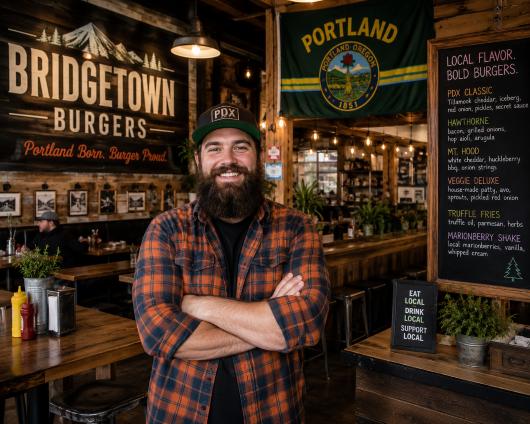
We know Bend's restaurant scene block by block
Bend's restaurant scene runs from a converted century-old sawmill to a newer walkable mixed-use development, with real wildfire history at the city's own edge and a tourism-driven demand swing to plan around. Here's what we watch for across its districts.
Old Mill District
Built on the site of the Shevlin-Hixon and Brooks-Scanlon lumber mills, once among the largest pine sawmills in the world at 500 million board feet a year. After the mills closed between 1950 and 1993, the roughly 270-acre site was redeveloped into today's mixed-use shopping and dining district, real adaptive-reuse of century-old industrial timber structures.
The Box Factory
Built in 1916 as part of the Brooks-Scanlon mill complex, the only surviving box-factory building in Bend. It fell into near-demolition condition before being acquired and restored in 2013 using historic-preservation techniques, now a 100,000-square-foot mixed commercial center, a real, dated example of older-building renovation risk for a food-service tenant.
Downtown Bend
Anchored by the O'Kane Building, built in 1916 as Bend's first reinforced-concrete building and listed on the National Register in 1985, plus the 1940 Tower Theatre. A dense, foot-traffic-heavy historic core of early-20th-century masonry and concrete buildings.
NorthWest Crossing
A 486-acre New Urbanist neighborhood on Bend's west side, its restaurant scene grew from sparse to established with a documented second-phase expansion adding four new local restaurants in 2021, a newer-construction exposure profile distinct from the historic core's older building stock.
Core coverage lines every Bend restaurant should evaluate
Restaurant insurance in Bend is a tailored bundle built around Oregon law, local licensing, and your lease. Here's what actually protects Bend food service businesses.
General Liability Insurance
Protects against third-party bodily injury and property damage claims. Responds when guests slip, suffer foodborne illness, or get injured during delivery. Most landlords require $1M/$2M before lease signing.
Commercial Property Insurance
Covers your kitchen equipment, refrigeration and HVAC, tenant improvements, inventory, and business personal property against fire, equipment breakdown, and theft.
Business Owner's Policy (BOP)
Bundles general liability, commercial property, and business interruption into one package. Works best for single-unit restaurants with annual revenue under $3 million.
Liquor Liability Insurance
Oregon requires a $300,000 minimum liquor liability as a condition of any OLCC license, and Bonner v. American Golf (2024) expanded negligence exposure at extreme intoxication.
Workers' Compensation Insurance
Covers medical expenses and lost wages for work-related injuries. Oregon requires coverage from the first employee, with no tip credit allowed anywhere in the state.
Business Interruption Insurance
Replaces lost income and covers ongoing expenses when covered events force shutdowns or reduced capacity. Limits should reflect 3 to 6 months of net income plus fixed expenses.
What restaurant insurance typically costs in Bend
A rough range based on real Oregon market data. Not a quote, just a starting point before you talk to an agent about your specific Bend location.
| Coverage Type | Typical Annual Range | Why It Varies |
|---|---|---|
| General Liability Insurance | $700–$2,000/yr | Scales with your lease terms and building age, especially in converted-industrial spaces like the Old Mill District and Box Factory. |
| Liquor Liability Insurance | $1,200–$4,000/yr | Oregon requires a $300,000 minimum as a condition of any OLCC license, and Bend's 30-plus-brewery tourism economy adds real, concentrated alcohol-service exposure. |
| Commercial Property w/ Wildfire Endorsement | $1,500–$5,000/yr | The 1990 Awbrey Hall Fire destroyed 22 homes and forced roughly 3,000 evacuations inside Bend's own urban fringe, and wildland-urban interface locations can face non-renewals from admitted carriers and referral to the FAIR Plan or surplus lines market. |
| Workers' Compensation | Payroll-class rated, seasonal-staffing sensitive | Mandatory from the first employee; Bend's tourism season, drawing 4.9 to 6 million visitor-days a year against a resident population of roughly 107,000, creates real seasonal-staffing demand swings. |
| Business Interruption Insurance | Rated by exposure, sized to visitor season | Covers lost revenue tied to Bend's real, documented visitor-day volume, which runs 5 to 6 times the resident population annually. |
| Full-Service w/ Liquor License, Bundled | $7,000–$16,000/yr | Restaurants in wildfire-adjacent locations or converted-industrial buildings should budget toward the higher end. |
Why Bend's wildfire history and tourism scale change what your policy needs to do
Bend restaurant coverage has to account for a real, documented wildfire history inside the city's own urban fringe and a genuine, large-scale brewery-tourism economy, on top of Oregon's statewide dram shop and liquor-liability framework.
The 1990 Awbrey Hall Fire is a real, documented anchor for wildfire coverage
The arson-caused Awbrey Hall Fire started in Shevlin Park in August 1990, jumped Skyliners Road, and burned 3,500 acres, destroying 22 homes and forcing the evacuation of roughly 3,000 people, with damages of about $9 million, hitting the Sunrise Village and Deschutes River Woods subdivisions directly, per documented retrospective coverage. This is real, in-town structure loss, not a distant-forest hypothetical.
Bend's brewery tourism is real and independently verified
Bend was home to Deschutes Brewery, founded in 1988 as the city's first brewery, and today anchors the 30-plus-brewery Bend Ale Trail. Visit Bend reported almost 1 million visitors in 2024 generating 4.9 to 6 million visitor-days, a real, documented demand base that runs several times the size of Bend's own resident population.
A late-summer wildfire threatens your Bend restaurant during peak tourist season.
A closer look at how Bend's real, documented risk factors actually play out.
A late-summer wildfire threatens your Bend restaurant during peak tourist season.
- The wildfire risk: The 1990 Awbrey Hall Fire destroyed 22 homes and forced 3,000 evacuations inside Bend's own urban fringe, real, documented proof this isn't a distant-forest risk for city-adjacent properties.
- The market squeeze: Wildland-urban interface locations in Oregon can face non-renewals from admitted carriers and referral to the FAIR Plan or surplus lines market.
- The revenue exposure: Bend's roughly 1 million annual visitors generate 4.9 to 6 million visitor-days a year, a wildfire-driven closure during peak season hits far harder than a flat annual average accounts for.
- The result: Coverage confirmed against your building's real wildfire exposure and sized to your actual peak-season revenue, not a generic assumption.
This is exactly why Bend-specific coverage matters. A generic Oregon policy doesn't automatically account for wildfire risk this documented or tourism demand this large.
Frequently asked questions
Has wildfire actually destroyed structures inside Bend before?
Yes. The 1990 Awbrey Hall Fire burned 3,500 acres starting in Shevlin Park, destroying 22 homes and forcing roughly 3,000 evacuations, with about $9 million in damages, hitting the Sunrise Village and Deschutes River Woods subdivisions inside Bend's own urban fringe.
Does Bend's wildfire risk zone affect where a restaurant can even get commercial property insurance?
Yes, in some cases significantly. Properties inside Deschutes County's high wildfire risk zones can face commercial property premiums of $8,000 to $25,000 or more, and some locations may need to be placed with a specialized surplus lines carrier rather than a standard admitted insurer if traditional carriers decline the risk. It's worth checking your specific address against Deschutes County's wildfire risk mapping before assuming standard commercial property coverage will be available at a standard rate.
How many tourists does Bend really draw compared to its population?
A lot relative to its size. Visit Bend reported almost 1 million visitors in 2024, generating 4.9 to 6 million visitor-days, against a city population of roughly 107,000 residents.
Does Oregon's dram shop law apply differently in Bend?
The same statewide standard applies. Bonner v. American Golf (October 2024) held that Oregon's dram shop liability shield is unconstitutional as applied to involuntary intoxication, allowing ordinary negligence claims once a patron has lost reason and volition.
What is the Old Mill District and why does its history matter for insurance?
A mixed-use shopping and dining district built on the site of two former lumber mills that were once among the largest pine sawmills in the world. Restaurants there occupy real, adaptive-reuse century-old industrial timber buildings, a different property-risk profile than ground-up new construction.
Get Bend restaurant coverage built around your actual neighborhood and real local risk.
Tell us your concept and your Bend neighborhood. We'll put together the coverage that actually applies.
Get Your Free Quote →