




Restaurant Insurance in Tulsa, Oklahoma
If you're a Tulsa restaurant owner searching for insurance that actually understands the flood that killed 14 people here in 1984, a state where courts hold vendors liable for over-serving a guest, and a Route 66 food hall built on the same historic alignment as the city's original auto-era gas stations, Insurance Kitchen builds coverage around that reality. The May 26-27, 1984 Memorial Day flood caused $180 million in damage and remade Tulsa's stormwater rules for good. We build Tulsa restaurant coverage around your actual neighborhood and local risk.
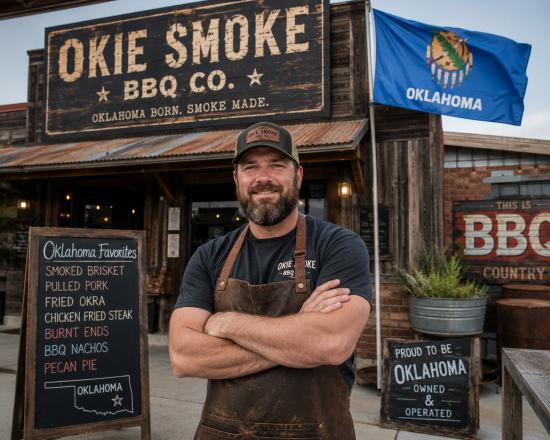
We know Tulsa's restaurant scene block by block
Tulsa's restaurant scene runs along a Route 66-era commercial corridor to a district shaped by one of the city's most significant historical events, with a documented flood history to plan around. Here's what we watch for across its neighborhoods.
Blue Dome District
Named for the Art Deco Blue Dome building, a former Gulf Oil station built in 1924 on Route 66's original 1926 alignment. Listed on the National Register of Historic Places in 2011, today a 17-block district dense with bars and restaurants.
Brady Arts District
A former warehouse and rail district listed on the National Register in 2010, redeveloped into a gallery, dining, and entertainment corridor near the Woody Guthrie Center and Cain's Ballroom.
Greenwood District
Once known as Black Wall Street, a thriving self-contained Black business community destroyed by the Tulsa Race Massacre of May 31-June 1, 1921. The district was listed on the National Register of Historic Places in 2022, and its restaurants and businesses today operate within a neighborhood whose history carries real civic weight.
Core coverage lines every Tulsa restaurant should evaluate
Restaurant insurance in Tulsa is a tailored bundle built around Oklahoma law, local licensing, and your lease. Here's what actually protects Tulsa food service businesses.
General Liability Insurance
Protects against third-party bodily injury and property damage claims. Responds when guests slip, suffer foodborne illness, or get injured during delivery. Most landlords require $1M/$2M before lease signing.
Commercial Property Insurance
Covers your kitchen equipment, refrigeration and HVAC, tenant improvements, inventory, and business personal property against fire, equipment breakdown, and theft.
Business Owner's Policy (BOP)
Bundles general liability, commercial property, and business interruption into one package. Works best for single-unit restaurants with annual revenue under $3 million.
Liquor Liability Insurance
Oklahoma has no single named dram shop act, but 37A O.S. § 6-101 bans selling to an intoxicated patron, and the Oklahoma Supreme Court held in Brigance v. Velvet Dove Restaurant (1986 OK 41) that a vendor owes a duty of care not to serve a visibly intoxicated guest, extended to off-premises sales in Boyle v. ASAP Energy (2017 OK 82).
Workers' Compensation Insurance
Covers medical expenses and lost wages for work-related injuries. Oklahoma sets no minimum employee count: 85A O.S. § 3(A) requires coverage the moment you have one non-exempt employee, with a narrow exception for a family business of five or fewer employees all related to the owner.
Business Interruption Insurance
Replaces lost income and covers ongoing expenses when covered events force shutdowns or reduced capacity. Limits should reflect 3 to 6 months of net income plus fixed expenses.
What restaurant insurance typically costs in Tulsa
A rough range based on real Oklahoma market data. Not a quote, just a starting point before you talk to an agent about your specific Tulsa location.
| Coverage Type | Typical Annual Range | Why It Varies |
|---|---|---|
| General Liability Insurance | $500–$2,500/yr | Scales with your landlord's required limits and your building's age, especially in the Blue Dome and Brady Arts districts. |
| Liquor Liability Insurance | $400–$2,200/yr | Oklahoma courts hold vendors liable for over-serving a visibly intoxicated guest, so most Tulsa leases and lenders require this coverage. |
| Commercial Property w/ Flood Endorsement | $1,200–$4,000/yr | The May 1984 Memorial Day flood caused $180 million in damage citywide, and Tulsa's proximity to the Arkansas River and Mingo Creek basin keeps flood coverage a real, not optional, question. |
| Workers' Compensation | $34–$150 per employee per month | Mandatory from your very first employee under Oklahoma law; there is no small-business headcount exemption to fall back on. |
| Business Owner's Policy (BOP), Bundled | $1,200–$3,800/yr | Bundles general liability and commercial property at a discounted rate, the standard starting point for most single-unit Tulsa restaurants. |
| Full-Service, Bundled | $4,200–$10,000/yr | Restaurants in older Blue Dome or Brady Arts buildings, or those running a full bar, should budget toward the higher end. |
Why the 1984 flood and Oklahoma's over-serving liability change what your policy needs to do
Tulsa restaurant coverage has to account for a documented flood event that remade the city's stormwater rules, and Oklahoma's legal framework where courts, not a single named act, decide when a restaurant is on the hook for over-serving a guest.
The 1984 Memorial Day flood rewrote how Tulsa manages stormwater
The May 26-27, 1984 flood dropped 6 to 15 inches of rain in about 8 hours near the Mingo Creek basin, killing 14 people, injuring 288, and damaging or destroying more than 5,500 buildings, per the National Weather Service's own account of the storm. Damage totaled $180 million, about $406 million in 2013 dollars. The flood led directly to Tulsa's modern stormwater management program, and by the early 1990s FEMA ranked Tulsa first nationally for floodplain management. Check your commercial property policy's flood coverage against a storm this severe regardless of that improved infrastructure.
Oklahoma courts, not a single statute, decide when a restaurant is liable for over-serving
Oklahoma has no formally named dram shop act, but the Oklahoma Supreme Court held in Brigance v. Velvet Dove Restaurant (1986 OK 41) that a restaurant or bar owes a duty of care not to serve alcohol to a visibly intoxicated guest, and Boyle v. ASAP Energy (2017 OK 82) extended that exposure to off-premises sales as well. That combination of a criminal statute (37A O.S. § 6-101) and real court decisions means liquor liability coverage responds to an actual, litigated risk here.
Heavy spring rain settles over Tulsa, and flood watches go up for the Mingo Creek and Arkansas River basins.
A closer look at how Tulsa's documented risk factors actually play out.
Heavy spring rain settles over Tulsa, and flood watches go up for the Mingo Creek and Arkansas River basins.
- The history: The May 1984 Memorial Day flood killed 14 people and caused $180 million in damage, a benchmark for how severe a single storm system can get here.
- The response: Tulsa built a nationally recognized stormwater management program after 1984, but that's a city-level fix, not a reason to skip confirming your own policy's flood coverage.
- The building-age question: If your restaurant occupies an older building in Blue Dome or Brady Arts, confirm your property policy's replacement-cost basis matches the building's actual age and construction.
- The fix: Confirmed flood and wind coverage under your commercial property policy, checked against a storm this severe, is what actually responds to a loss.
This is exactly why Tulsa-specific coverage matters. A generic statewide policy doesn't automatically account for flood risk documented at this scale.
Frequently asked questions
How much does restaurant insurance cost in Tulsa?
Restaurant insurance in Tulsa typically runs $3,000 to $10,000 per year for a standard package combining general liability, commercial property, and workers' compensation. General liability runs $500 to $2,500 per year; commercial property with a flood endorsement runs $1,200 to $4,000 per year; workers' compensation, mandatory from your first non-exempt employee, runs roughly $34 to $150 per employee per month. Liquor liability runs $400 to $2,200 per year.
Can a Tulsa restaurant be held liable for over-serving a customer?
Yes. Oklahoma doesn't have a single named dram shop act, but 37A O.S. § 6-101 bans selling alcohol to an intoxicated person, and the Oklahoma Supreme Court held in Brigance v. Velvet Dove Restaurant (1986) that vendors owe a duty of care not to serve a visibly intoxicated guest. Boyle v. ASAP Energy (2017) extended that liability to off-premises sales as well.
Does Tulsa's flood history affect commercial property insurance?
Yes. The May 1984 Memorial Day flood killed 14 people and caused $180 million in damage citywide, and Tulsa's location along the Arkansas River and Mingo Creek basin keeps flood exposure a real underwriting factor. Review your commercial property policy's flood coverage rather than assuming standard wind coverage extends to water damage.
Do restaurants in the Blue Dome or Brady Arts districts cost more to insure?
Often, yes. Both districts are built around early-1900s warehouse and commercial buildings, and insuring a structure that age typically costs more than new construction because of higher replacement costs for period materials and the likelihood of older electrical or plumbing systems.
Is workers' compensation required for a small Tulsa restaurant with only a few employees?
Almost always, yes. Oklahoma sets no minimum employee count for workers' compensation: 85A O.S. § 3(A) requires coverage the moment you have one non-exempt employee. The narrow exception is a family-business exemption limited to five or fewer employees who are all related to the owner within the second degree of blood or marriage.
Get Tulsa restaurant coverage built around your actual neighborhood and real local risk.
Tell us your concept and your Tulsa neighborhood. We'll put together the coverage that actually applies.
Get Your Free Quote →