




Restaurant Insurance in St. Petersburg, Florida
St. Petersburg restaurants took two separate federally declared hurricanes inside a fortnight in 2024, and the policy consequence is not the one most owners expect. Helene and Milton were declared as distinct disasters with overlapping incident periods, which is what turns one bad autumn into two hurricane deductibles rather than one. On the liability side, Florida's responsible vendor rules run on two different training clocks, and missing the shorter one is the common error in a high-turnover Central Avenue kitchen.
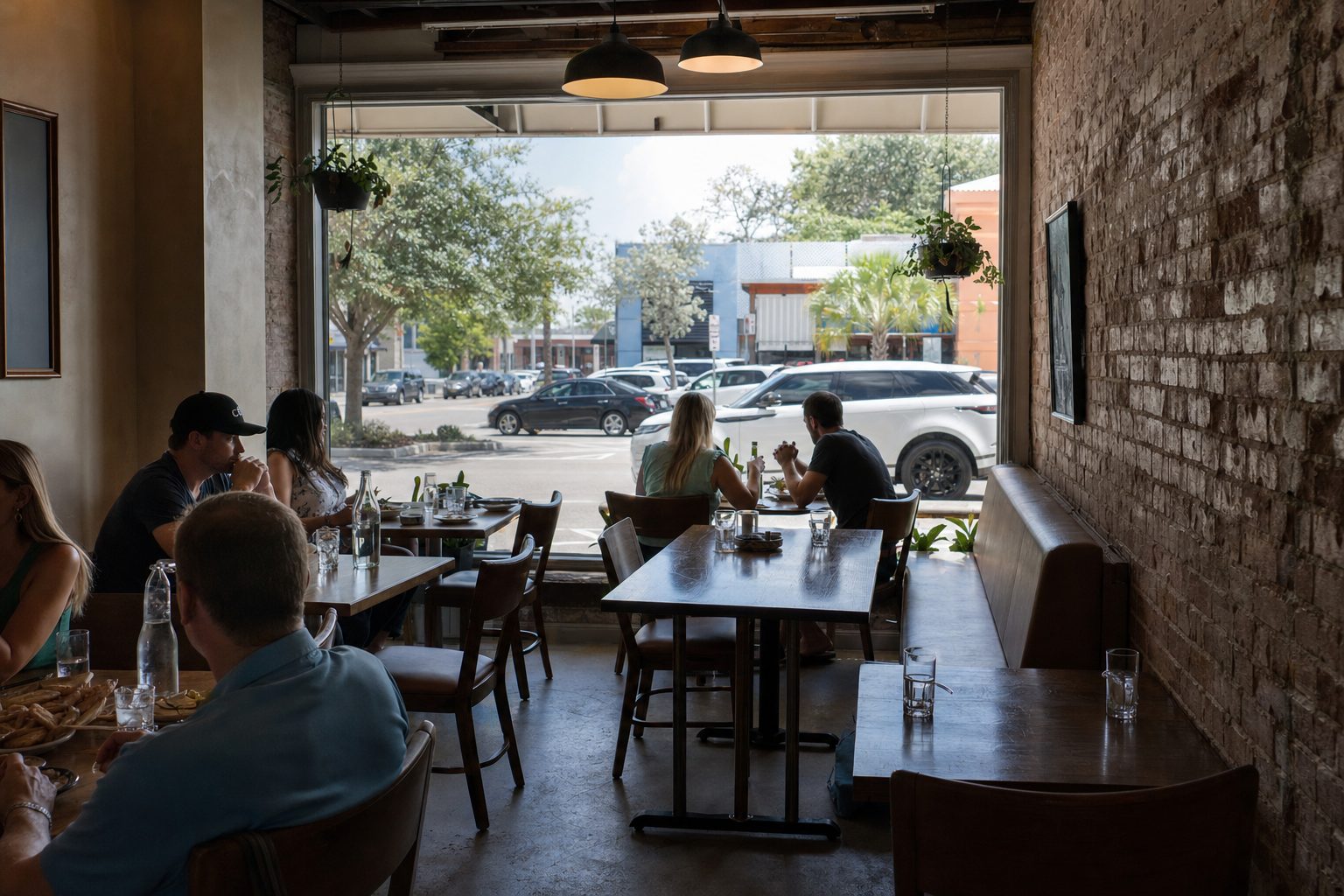
We know St. Petersburg's restaurant corridors block by block
St. Pete runs a dense, walkable dining economy spread across several distinct corridors, each with its own mix of alcohol share, building stock and storm exposure.
Downtown waterfront and Beach Drive
Dining rooms sitting closest to Tampa Bay, where surge rather than wind speed is the governing property question. Elevation and ground-floor finishes drive the loss here more than roof age does.
Central Avenue and the EDGE District
A concentrated run of bars, taprooms and restaurants where alcohol is frequently the lead product. Classification turns on alcohol share of revenue, and it moves the liquor premium sharply.
Grand Central District
An independent-operator corridor that hires and rehires constantly. Turnover is exactly the condition the responsible vendor training deadlines were written for, and the one most likely to let a server slip past them.
The Deuces, 22nd Street South
Neighborhood restaurants where a closure of a few weeks is an existential event rather than a bad quarter. Income protection carries more weight here than a higher property limit would.
Citywide, four employees and up
Florida brings private employers under the chapter at four employees, counted across the whole payroll. Seasonal hiring pushes operators over that line without anyone deciding to cross it.
Core coverage lines every St. Petersburg restaurant should evaluate
A St. Petersburg policy is a stack of separate coverages, and 2024 made two of them concrete: how many deductibles a season can trigger, and how long income protection has to last.
General Liability Insurance
Central Avenue foot traffic and outdoor seating put guests on varied surfaces across a long service day. This is the line that answers a slip on a wet patio, a guest hurt by furniture, or damage you cause to a neighboring unit.
Commercial Property Insurance
Two declared hurricanes in one season is the argument for reading the deductible clause rather than the limit. A percentage hurricane deductible applies per occurrence, so separate named storms generally mean separate retentions before the policy pays anything.
Business Owner's Policy (BOP)
One EDGE District kitchen or a single Grand Central cafe usually fits a business owner's policy, which places property and general liability together below the cost of buying them apart.
Liquor Liability Insurance
Florida's responsible vendor standard runs on two clocks, not one. A nonmanagerial employee serving alcohol has 30 days from starting work to finish the employee course and must be supervised in service until they do, while a managerial employee has only 15 days to complete the manager course.
Workers' Compensation Insurance
The penalty for going without is calculated from your own payroll. Under section 440.107 Florida assesses twice the premium you would have paid at approved manual rates for the uninsured period in the preceding 12 months, or $1,000, whichever is larger.
Business Interruption Insurance
A storm that spares the building can still close the block, and a storm that does not spare it can close you for a season. Business interruption answers for the income missed while the doors stay shut.
What restaurant insurance typically costs in St. Petersburg
St. Petersburg prices close to the Florida coastal norm, with the deductible structure mattering more than the headline premium. Treat the figures below as market context rather than a quoted price.
| Coverage Type | Typical Annual Range | Why It Varies in St. Petersburg |
|---|---|---|
| General Liability Insurance | $700-$2,000/yr | Driven by guest volume and outdoor seating more than by which corridor you sit on. |
| Commercial Property (wind-rated) | $2,200-$7,000/yr | Surge exposure near the waterfront and the per-occurrence hurricane deductible both sit in this line. |
| Liquor Liability Insurance | $1,100-$3,200/yr | Central Avenue and EDGE District alcohol-led revenue mixes move this well above a food-led operation. |
| Workers' Compensation | Payroll-class rated | Priced off payroll and job classification; the exposure begins at the fourth employee and the uninsured penalty is calculated as a multiple of the premium avoided. |
| Small Cafe, Bundled | $4,000-$7,500/yr | Where a Grand Central or Deuces room serving beer and wine only tends to land. |
| Full-Service w/ Alcohol, Bundled | $9,500-$20,000+/yr | The upper end reflects waterfront exposure and alcohol-led revenue. |
Why 2024 left St. Petersburg owners with two deductibles instead of one
Most Florida cities discuss hurricane season as a single annual event. Pinellas County spent 2024 proving it does not work that way. Two separate disasters were declared less than two weeks apart, and because a hurricane deductible applies per occurrence rather than per season, a restaurant damaged by both generally retains twice.
Two declarations, thirteen days apart
FEMA declared DR-4828, Florida Hurricane Helene, with an incident period beginning 23 September 2024, and DR-4834, Florida Hurricane Milton, beginning 5 October 2024. Pinellas County was designated under both, and the two incident periods overlap. Separate occurrences are what drive separate retentions.
Two training clocks, not one
Under Florida Statute 561.705, a responsible vendor must have each nonmanagerial server complete the employee course within 30 days of starting and supervise them until it is done, while each managerial employee has 15 days for the manager course. The payoff sits in 561.706: a qualified vendor cannot have its license suspended or revoked for a trained employee's illegal sale, unless the vendor knew, should have known, or took part.
How two named storms in one season change a Pinellas County property claim
The limit is rarely the surprise. The deductible structure is, and 2024 is the year that made it concrete for St. Petersburg operators.
Your Beach Drive dining room is damaged in late September, then again in early October
- The setting: Helene's incident period opens 23 September and Milton's opens 5 October. Pinellas County is designated under both declarations, and your building takes damage in each.
- The gap: A hurricane deductible is normally written as a percentage of the insured value and applies per occurrence. Two named storms are two occurrences, so the retention is taken twice before recovery begins, which is not how most owners budget for a season.
- The fix: The deductible basis is read before the season rather than after it, the calendar-year or single-season deductible options available in some Florida forms are priced deliberately, and the business interruption period is set against back-to-back closures instead of one.
- The result: A retention you chose with the arithmetic in front of you, rather than one discovered on the second claim.
Accepting a per-occurrence hurricane deductible is a defensible decision. Being surprised by the second one is not.
Frequently asked questions
How much does restaurant insurance cost in St. Petersburg, Florida?
A full-service St. Petersburg restaurant serving alcohol commonly runs $9,500 to $20,000 or more a year once property, general liability, liquor liability and workers' compensation are placed together. A smaller cafe without full alcohol service more often lands between $4,000 and $7,500. Waterfront exposure and alcohol share of revenue are the two factors that move it most.
Do I pay a separate hurricane deductible for each storm?
Usually yes. Hurricane deductibles are typically written per occurrence, so two named storms mean two retentions. Pinellas County was designated under both the Helene and the Milton declarations in 2024, with incident periods beginning 23 September and 5 October, which is exactly the pattern that produces two deductibles in one season.
How quickly do my servers have to be trained in Florida?
Florida Statute 561.705 sets two deadlines. A nonmanagerial employee who serves alcohol has 30 days from starting work to complete the employee course, and must be supervised in the service of alcohol until the training is finished. A managerial employee has 15 days to complete the separate manager course.
What is the penalty for running a St. Petersburg restaurant without workers' comp?
Florida assesses a penalty equal to twice what you would have paid in premium at approved manual rates on your payroll for the periods you were uninsured within the preceding 12 months, or $1,000, whichever is greater. The department can also issue a stop-work order, which halts trading until the coverage and the penalty are settled.
Does responsible vendor status actually protect my license?
It can. Florida Statute 561.706 provides that a qualified responsible vendor's license may not be suspended or revoked for an employee's illegal sale to an underage person where that employee had completed the prescribed training beforehand, unless the vendor knew of the violation, should have known, or participated in it.
Is business interruption worth buying if my building survives the storm?
Often, though the trigger wording decides it. Many forms respond only to income lost through direct physical damage to your own property, so a closure caused by a shut road or a power outage elsewhere may fall outside them. Civil authority and ingress-egress extensions are the provisions to read closely in a surge-exposed city.
Get St. Petersburg restaurant coverage that is priced for a two-storm season.
Tell us the corridor, the concept and how much of your revenue is alcohol. We'll build a St. Petersburg program that treats the deductible structure and your training calendar as decisions rather than defaults.
Get Your Free Quote →