




Restaurant Insurance in Mystic, Connecticut
If you're a Mystic restaurant owner searching for insurance that actually understands the real 250,000 annual visitors drawn by the largest maritime museum in the country, a century-old drawbridge that still stops downtown traffic on a fixed schedule, and a village of just 4,348 year-round residents built almost entirely around tourism, Insurance Kitchen builds coverage around that reality. Mystic Seaport Museum, founded in 1929, draws roughly 250,000 visitors a year to a village smaller than many single neighborhoods. We build Mystic restaurant coverage around your actual season and real local risk.
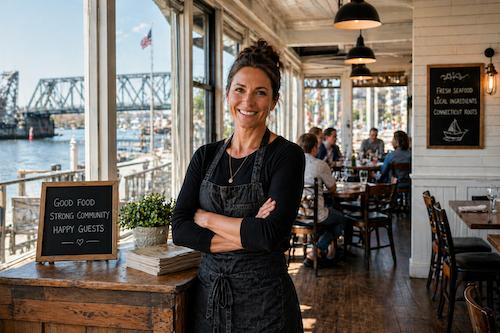
We know Mystic's restaurant scene block by block
Mystic's restaurant scene is built almost entirely around one historic maritime museum and the downtown drawbridge district beside it, with real, documented hurricane history and extreme seasonal tourism swings to plan around. Here's what we watch for across the village.
Mystic Seaport Museum
Founded in 1929, spanning 19 acres and described as the largest maritime museum in the United States. Home to four vessels holding National Historic Landmark status, including the 1841 whaling ship Charles W. Morgan, and drawing roughly 250,000 visitors a year, real, sustained tourist traffic for nearby restaurants.
Mystic River Bascule Bridge Corridor
The bridge itself was built in 1922 and still opens on a fixed schedule, hourly during daylight hours from May through October, an estimated 2,200 times a year for boat traffic, while carrying roughly 11,800 vehicles a day. Real, documented, recurring traffic patterns that shape foot traffic for every restaurant along this downtown corridor.
Core coverage lines every Mystic restaurant should evaluate
Restaurant insurance in Mystic is a tailored bundle built around Connecticut law, local licensing, and your lease. Here's what actually protects Mystic food service businesses.
General Liability Insurance
Protects against third-party bodily injury and property damage claims. Responds when guests slip, suffer foodborne illness, or get injured during delivery. Most landlords require $1M/$2M before lease signing.
Commercial Property Insurance
Covers your kitchen equipment, refrigeration and HVAC, tenant improvements, inventory, and business personal property against fire, equipment breakdown, and theft.
Business Owner's Policy (BOP)
Bundles general liability, commercial property, and business interruption into one package. Works best for single-unit restaurants with annual revenue under $3 million.
Liquor Liability Insurance
Connecticut's Dram Shop Act (Conn. Gen. Stat. § 30-102) caps total recovery at $250,000 per incident, but that cap doesn't reduce the cost of defending a claim before it's resolved.
Workers' Compensation Insurance
Covers medical expenses and lost wages for work-related injuries. Mandatory in Connecticut from your very first employee, full-time, part-time, or seasonal, with no small-business exemption.
Business Interruption Insurance
Replaces lost income and covers ongoing expenses when covered events force shutdowns or reduced capacity. Limits should reflect 3 to 6 months of net income plus fixed expenses.
What restaurant insurance typically costs in Mystic
A rough range based on real Connecticut market data. Not a quote, just a starting point before you talk to an agent about your specific Mystic location.
| Coverage Type | Typical Annual Range | Why It Varies |
|---|---|---|
| General Liability Insurance | $500–$2,500/yr | Scales with your landlord's required limits and your building's age, especially in the historic downtown district near the bridge. |
| Liquor Liability Insurance | $1,000–$3,500/yr | Connecticut's Dram Shop Act caps total recovery at $250,000 per incident, real underlying exposure for a tourism-driven restaurant scene with heavy seasonal alcohol sales. |
| Commercial Property w/ Coastal Endorsement | $2,000–$6,000/yr | Standard property policies exclude flood damage; Mystic's direct exposure to Long Island Sound and the Mystic River means insurers often require a separate windstorm deductible on top of a standard policy. |
| Workers' Compensation | $0.75–$2.50 per $100 of payroll | Mandatory in Connecticut from your very first employee; seasonal staffing swings around Mystic's tourism calendar make pay-as-you-go structures worth discussing with your agent. |
| Business Owner's Policy (BOP), Bundled | $2,000–$6,000/yr | Bundles general liability and commercial property at a discounted rate, the standard starting point for most single-unit Mystic restaurants. |
| Full-Service w/ Liquor License, Bundled | $8,500–$22,000/yr | High-volume restaurants or bars near the Seaport or downtown bridge corridor should budget toward the higher end. |
Why Mystic's tourism scale and hurricane history change what your policy needs to do
Mystic restaurant coverage has to account for a village whose tourism volume dwarfs its year-round population and real, documented Long Island Sound hurricane history, on top of Connecticut's statewide dram shop framework.
Mystic's tourism scale is real and genuinely disproportionate to its size
Mystic Seaport Museum, founded in 1929 on 19 acres, draws an estimated 250,000 visitors a year, per documented museum history, against a village of just 4,348 year-round residents per the 2020 Census. That volume, concentrated heavily in the warmer months, is exactly why seasonal staffing and revenue swings deserve real attention in a Mystic restaurant's coverage, not a flat annual assumption.
The 1938 hurricane hit Mystic hard enough to leave a documented, vivid record
The 1938 hurricane, the same storm that made its deadly second landfall near New Haven, struck the broader Mystic/Stonington area hard enough that in nearby Stonington, buildings were swept off their foundations and found two miles inland, per documented storm history. In Mystic itself, rescuers reportedly found live fish and crabs in kitchen drawers and cabinets while searching flooded homes for survivors, real, documented proof of how severe storm surge here can get.
A hurricane tracks up Long Island Sound during Mystic's peak summer tourist season.
A closer look at how Mystic's real, documented risk factors actually play out.
A hurricane tracks up Long Island Sound during Mystic's peak summer tourist season.
- The history: The 1938 hurricane hit this stretch of coastline hard enough that Stonington buildings were swept two miles inland and Mystic homes flooded to the point rescuers found fish and crabs inside kitchen drawers, real, documented proof of the storm-surge risk here.
- The exclusion: Standard commercial property policies exclude flood and storm-surge damage entirely, and Mystic's direct Sound exposure often means insurers require a separate windstorm deductible on top.
- The seasonal question: With roughly 250,000 annual visitors concentrated against a year-round population of just 4,348, a storm that hits during peak season costs a Mystic restaurant far more in lost revenue than a flat annual average accounts for.
- The fix: Flood coverage confirmed and in place before hurricane season, plus a business interruption policy sized to your real seasonal revenue concentration, closes the gap a generic policy leaves open.
This is exactly why Mystic-specific coverage matters. A generic Connecticut policy doesn't automatically account for tourism this concentrated or storm-surge risk this well documented.
Frequently asked questions
How much does restaurant insurance cost in Mystic, Connecticut?
Comprehensive restaurant insurance in Mystic typically costs $4,000 to $15,000 per year for a standard full-service establishment, running roughly 20% above the national average given Mystic's coastal, high-traffic tourist profile. A small cafe or takeout spot might pay $2,000 to $5,000 annually, while high-volume restaurants or bars with heavy alcohol sales can see $8,500 to $22,000 or more. A Business Owner's Policy runs $2,000 to $6,000 per year; workers' compensation, mandatory from your first employee, runs $0.75 to $2.50 per $100 of payroll; liquor liability runs $1,000 to $3,500 per year, capped at $250,000 per incident under Connecticut's Dram Shop Act.
Does Connecticut cap dram shop liability for over-served patrons?
Yes. Conn. Gen. Stat. § 30-102 caps total recovery at $250,000 per incident regardless of how many people are hurt, and it's the exclusive legal remedy for an adult 21 or older. Written notice of intent to sue is required within 120 days of the incident.
Does being near the water in Mystic mean a restaurant needs separate flood insurance?
Yes. Standard commercial property policies exclude flood damage entirely regardless of proximity to the water, and Mystic's direct exposure to Long Island Sound and the Mystic River means insurers often require a separate windstorm deductible on top of a standard policy. The 1938 hurricane's documented local impact, homes flooded badly enough that rescuers found fish and crabs inside kitchen drawers, is real proof of the exposure here.
Does Mystic's seasonal tourism swing affect a restaurant's insurance costs?
Yes, meaningfully. Mystic Seaport Museum alone draws an estimated 250,000 visitors a year against a village of just 4,348 year-round residents, a real, extreme seasonal concentration. Workers' compensation and liquor liability exposure both scale up during peak season, so a pay-as-you-go staffing structure and a business interruption policy sized to your real seasonal revenue are both worth discussing with your agent rather than budgeting a flat year-round average.
Do Mystic's historic downtown buildings cost more to insure?
Often, yes. Many dining spots in downtown Mystic occupy older buildings near the historic 1922 bascule bridge, and insuring one typically costs more than insuring new construction unless the electrical and plumbing systems have been fully modernized. It's worth confirming your property policy's replacement-cost basis actually reflects your building's real age and construction rather than a generic estimate.
Get Mystic restaurant coverage built around your actual neighborhood and real local risk.
Tell us your concept and your Mystic neighborhood. We'll put together the coverage that actually applies.
Get Your Free Quote →