




Restaurant Insurance in Colorado Springs, Colorado
If you're a Colorado Springs restaurant owner searching for insurance that actually understands the city's real wildfire history, its unusual dry-town founding story, and neighborhoods from Old Colorado City to Ivywild, Insurance Kitchen builds coverage around that reality. This region endured two of Colorado's most destructive wildfires within a single year, the 2012 Waldo Canyon Fire and the 2013 Black Forest Fire, a real reminder that property risk here goes beyond hail alone. We build Colorado Springs restaurant coverage around your actual location and wildfire exposure.
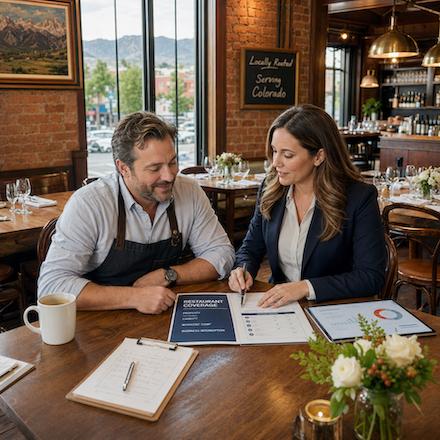
We know Colorado Springs's restaurant scene block by block
Colorado Springs was founded as a strict temperance town right next to a notoriously wet saloon town, and its restaurant map still reflects that contrast today. Here's what we watch for across its districts.
Old Colorado City Historic District
Founded in 1859 as the original wet, saloon-heavy Colorado City, later annexed by Colorado Springs in 1917. Historic 1880s-era brick storefronts raise older-building property risk alongside a long liquor-culture history.
Downtown / Tejon Street corridor
Colorado Springs itself was founded in 1871 by General William Jackson Palmer as a strict temperance town, a direct contrast to neighboring Colorado City. Today's dense downtown restaurant row carries concentrated liquor liability and foot-traffic exposure.
Ivywild
A 1916 elementary school closed in 2009 and reopened in 2013 as a multi-tenant food and drink hall. Adaptive reuse of a century-old public building for food service carries a distinct shared-kitchen and occupancy-class liability profile.
Mountain Shadows
A northwest foothills neighborhood where the 2012 Waldo Canyon Fire destroyed 346 homes. Any restaurant in this wildland-urban-interface zone faces real, documented wildfire exposure.
Manitou Springs (adjacent resort town)
A mineral-springs resort town founded in 1872 at the base of Pikes Peak. A tourist-dependent, seasonal restaurant economy carries different business-interruption exposure than a year-round Colorado Springs location.
Core coverage lines every Colorado Springs restaurant should evaluate
Restaurant insurance in Colorado Springs is a tailored bundle built around Colorado law, local licensing, and your lease. Here's what actually protects Colorado Springs food service businesses.
General Liability Insurance
Protects against third-party bodily injury and property damage claims. Responds when guests slip, suffer foodborne illness, or get injured during delivery. Most landlords require $1M/$2M before lease signing.
Commercial Property Insurance
Covers your kitchen equipment, refrigeration and HVAC, tenant improvements, inventory, and business personal property against fire, equipment breakdown, and theft.
Business Owner's Policy (BOP)
Bundles general liability, commercial property, and business interruption into one package. Works best for single-unit restaurants with annual revenue under $3 million.
Liquor Liability Insurance
Protects restaurants serving alcohol from dram shop claims. Restaurants with liquor licenses typically must carry liquor liability coverage to maintain their permit.
Workers' Compensation Insurance
Covers medical expenses and lost wages for work-related injuries. Coverage requirements are set at the state level and apply to restaurants with employees.
Business Interruption Insurance
Replaces lost income and covers ongoing expenses when covered events force shutdowns or reduced capacity. Limits should reflect 3 to 6 months of net income plus fixed expenses.
What restaurant insurance typically costs in Colorado Springs
A rough range based on real Colorado market data. Not a quote, just a starting point before you talk to an agent about your specific Colorado Springs location.
| Coverage Type | Typical Annual Range | Why It Varies in Colorado Springs |
|---|---|---|
| General Liability Insurance | $500–$1,800/yr | Scales with your landlord's required limits and your building's proximity to Colorado's most hail-intense corridors. |
| Commercial Property (Hail-Rated) | $1,500–$5,000/yr | Colorado's Front Range sits in one of the most hail-intense corridors in the U.S., and a 2% hail deductible on a $1.5 million property schedule means $30,000 out of pocket before coverage responds. |
| Liquor Liability Insurance | $1,000–$3,500/yr | Colorado's year-round patio culture extends liability beyond the building envelope, and dram shop claims can be costly in dense entertainment districts. |
| Workers' Compensation | Payroll-class rated | Mandatory for every Colorado employer with one or more employees under CRS § 8-40-101, no minimum headcount, priced by payroll and job classification. |
| Mountain/Resort Wildfire Adjacency | 1.25x multiplier | This region endured two of Colorado's most destructive wildfires within a single year, the 2012 Waldo Canyon Fire and the 2013 Black Forest Fire, a real factor for any location near the foothills. |
| Full-Service w/ Alcohol, Bundled | $8,000–$17,000/yr | Estimated annual range for a full Colorado coverage program, scaled by alcohol service and location. |
Why this region saw two of Colorado's most destructive wildfires in one year
Colorado Springs restaurant coverage has to account for a genuinely rare back-to-back wildfire history and a distinctive dry-town founding story, on top of El Paso County Public Health's food safety permitting.
Two of Colorado's most destructive wildfires hit this region within one year
The 2012 Waldo Canyon Fire burned 18,247 acres and destroyed 346 homes in the Mountain Shadows neighborhood, at the time the most destructive wildfire in Colorado history. Less than a year later, the 2013 Black Forest Fire burned 14,280 acres and destroyed 489 homes nearby, surpassing Waldo Canyon's record. Any restaurant near the foothills should confirm current wildfire-zone status directly with property coverage.
Colorado Springs was founded dry, right next to a wet saloon town
General William Jackson Palmer founded Colorado Springs in 1871 as a strict temperance town, while neighboring Colorado City (now Old Colorado City) built its economy on saloons and liquor sales. Confirm your current liquor licensing steps directly with the City of Colorado Springs, since Colorado is a dual local-then-state licensing process.
How the region's wildfire history affects a Mountain Shadows-area restaurant
Colorado Springs's back-to-back wildfire history is a real, specific factor that a generic Colorado policy doesn't fully account for.
You're opening a restaurant near the northwest foothills, in an area that has seen real, documented wildfire activity in the past 15 years.
- The history: The 2012 Waldo Canyon Fire destroyed 346 homes in Mountain Shadows, and the 2013 Black Forest Fire destroyed 489 homes nearby less than a year later, back-to-back events that reshaped how the region assesses wildfire risk.
- The gap: A property policy priced without confirming current wildland-urban-interface zone status may understate real risk for a specific foothills-adjacent address.
- The fix: Property coverage is reviewed against your building's actual wildfire-zone designation and this real, back-to-back fire history.
- The result: Coverage that reflects the region's real, documented wildfire track record.
This is exactly why Colorado Springs-specific coverage matters. A generic Colorado policy doesn't automatically account for a wildfire history this recent and this severe.
Frequently asked questions
What insurance is required to open a restaurant in Colorado Springs, Colorado?
Colorado requires workers' compensation for every employer with one or more employees under CRS § 8-40-101, no minimum headcount, general liability to meet most lease agreements, and a food license through El Paso County Public Health. A City of Colorado Springs liquor license is required separately if you serve alcohol, following the state's dual local-then-state approval process.
Did Colorado Springs really have two major wildfires in one year?
Yes. The 2012 Waldo Canyon Fire destroyed 346 homes in the Mountain Shadows neighborhood, and the 2013 Black Forest Fire destroyed 489 homes nearby less than a year later, surpassing Waldo Canyon's record as Colorado's most destructive wildfire by structures lost at the time.
How much does restaurant insurance cost in Colorado Springs, Colorado?
Colorado Springs restaurants generally fall within the statewide range of $4,000 to $8,000 a year for a full insurance package, with general liability alone running $1,300-$4,800/yr. Workers' compensation is mandatory for any employer with an employee, and Colorado's dram shop law (C.R.S. § 44-3-801) makes dedicated liquor liability coverage essential for any restaurant serving alcohol, since standard general liability doesn't cover over-service claims and the statutory recovery cap has climbed to $465,730 per claimant.
What is Ivywild, and why does its building matter for insurance?
Ivywild is a 1916 elementary school building that closed in 2009 and reopened in 2013 as a multi-tenant food and drink hall. Adaptive reuse of a century-old public building for food and alcohol service carries a distinct shared-kitchen and occupancy-class risk profile worth reviewing directly.
Does Manitou Springs' tourist economy affect nearby restaurant insurance needs?
It can. Manitou Springs is a seasonal, tourist-dependent resort town at the base of Pikes Peak, and a restaurant relying heavily on seasonal visitor traffic carries different business-interruption exposure than a year-round Colorado Springs location, worth factoring into your coverage.
Get Colorado Springs restaurant coverage built around your actual location and wildfire exposure.
Tell us your concept and your Colorado Springs neighborhood. We'll put together the coverage that actually applies.
Get Your Free Quote →