




Restaurant Insurance in Boulder, Colorado
If you're a Boulder restaurant owner searching for insurance that actually understands the city's pedestrian-only Pearl Street Mall, real foothills wildfire history, and a genuine 1971 height-limit ordinance that shapes every buildout, Insurance Kitchen builds coverage around that reality. Boulder's 55-foot citywide building height limit, voter-approved in 1971 specifically to preserve views of the Flatirons, is a real zoning fact that affects how every restaurant space gets built out. We build Boulder restaurant coverage around your actual district and wildfire exposure.
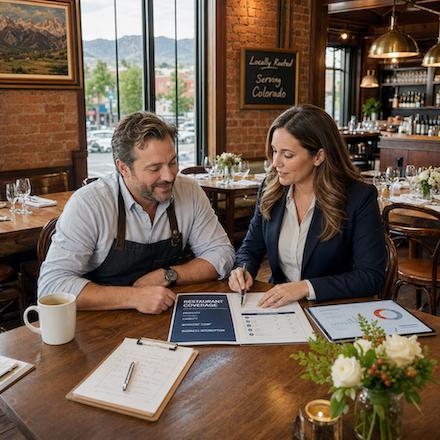
We know Boulder's restaurant scene block by block
Boulder's restaurant scene runs through a car-free downtown mall and right up against a real, documented wildfire-prone foothills edge. Here's what we watch for across its districts.
Pearl Street Mall
A 4-block pedestrian-only zone built in 1977, with restaurants now expanding seating directly into former street lanes under a formal outdoor dining pilot program. Dining on converted public right-of-way is a genuinely distinct liability exposure most cities don't have.
University Hill
The commercial strip directly adjacent to the University of Colorado Boulder campus. Nightlife tied to a college-age patron base raises overserving and crowd-control exposure tied to the academic calendar.
Foothills / wildland-urban-interface corridor
The 2010 Fourmile Canyon Fire burned 6,181 acres and destroyed 169 homes just west of Boulder. Restaurants in these foothill-adjacent corridors face real, documented wildfire exposure.
29th Street corridor
The only area in Boulder with an exception to the citywide 55-foot height cap. Buildout and tenant-improvement planning here differs from the rest of height-restricted Boulder.
Core coverage lines every Boulder restaurant should evaluate
Restaurant insurance in Boulder is a tailored bundle built around Colorado law, local licensing, and your lease. Here's what actually protects Boulder food service businesses.
General Liability Insurance
Pearl Street Mall has been pedestrian-only since 1977, and restaurants now push seating into what used to be roadway, which extends premises responsibility past the front door. Third-party bodily injury and property damage claims sit with general liability.
Commercial Property Insurance
The 29th Street corridor holds Boulder's only exception to the citywide 55-foot height cap, which makes build-out planning there unlike anywhere else in the city. Tenant improvements, equipment, refrigeration and inventory should be scheduled against actual buildout cost.
Business Owner's Policy (BOP)
University Hill's compact strip beside the CU Boulder campus is full of single-location operators, the profile this package is priced for, combining liability, property and business interruption.
Liquor Liability Insurance
Protects restaurants serving alcohol from dram shop claims. Restaurants with liquor licenses typically must carry liquor liability coverage to maintain their permit.
Workers' Compensation Insurance
The duties continue after the policy is bought. A Boulder employer must display the Notice to Employer of Injury poster at all times, keep a record of every lost-time injury and occupational disease, report injuries to the carrier within 10 days, and maintain a designated provider list for injured workers.
Business Interruption Insurance
The 2010 Fourmile Canyon Fire burned 6,181 acres and destroyed 169 homes immediately west of Boulder. For restaurants along the wildland-urban interface, wildfire closure is documented local history, and limits belong at three to six months.
What restaurant insurance typically costs in Boulder
A rough range based on real Colorado market data. Not a quote, just a starting point before you talk to an agent about your specific Boulder location.
| Coverage Type | Typical Annual Range | Why It Varies in Boulder |
|---|---|---|
| General Liability Insurance | $500–$1,800/yr | Scales with your landlord's required limits and your building's proximity to Colorado's most hail-intense corridors. |
| Commercial Property (Hail-Rated) | $1,500–$5,000/yr | Colorado's Front Range sits in one of the most hail-intense corridors in the U.S., and a 2% hail deductible on a $1.5 million property schedule means $30,000 out of pocket before coverage responds. |
| Liquor Liability Insurance | $1,000–$3,500/yr | Colorado's year-round patio culture extends liability beyond the building envelope, and dram shop claims can be costly in dense entertainment districts. |
| Workers' Compensation | Payroll-class rated | Mandatory for every Colorado employer with one or more employees under CRS § 8-40-101, no minimum headcount, priced by payroll and job classification. |
| Mountain/Resort Wildfire Adjacency | 1.25x multiplier | The 2010 Fourmile Canyon Fire burned 6,181 acres and destroyed 169 homes just west of Boulder, a real factor in property premiums for foothills-adjacent locations. |
| Full-Service w/ Alcohol, Bundled | $8,000–$17,000/yr | Estimated annual range for a full Colorado coverage program, scaled by alcohol service and location. |
Why Boulder's 1971 height ordinance shapes every restaurant buildout
Boulder restaurant coverage has to account for a real, voter-approved zoning ordinance and documented foothills wildfire history, on top of Boulder County's food safety permitting.
Boulder has capped building height at 55 feet since 1971
Boulder voters approved a citywide 55-foot building height limit in 1971 specifically to preserve mountain and Flatirons views, with most areas further restricted to 35 feet and a notable exception around 29th Street. This real, long-standing ordinance affects buildout planning and equipment placement for every Boulder restaurant space.
The Fourmile Canyon Fire is a real benchmark for Boulder's foothills risk
The 2010 Fourmile Canyon Fire ignited just west of Boulder, burned 6,181 acres, and destroyed 169 homes, at the time the most destructive wildfire in Colorado history. Confirm your current liquor licensing steps directly with the City of Boulder, and confirm wildfire-zone status directly with property coverage if you're near the foothills.
How Boulder's Outdoor Dining Pilot Program changes liability on Pearl Street
Boulder's pedestrian-mall dining rules are a real, specific factor that a generic Colorado policy doesn't fully account for.
You're opening a restaurant on West Pearl Street, expanding seating into what used to be a public street lane.
- The program: Boulder's Outdoor Dining Pilot Program lets restaurants seek outdoor dining approval, then apply for a liquor license modification referencing that approval, with an annual fee for use of the space.
- The gap: A liability policy assumed to cover only your leased interior space may not reflect that your seating now sits on converted public right-of-way.
- The fix: General liability and liquor liability coverage are reviewed against your actual outdoor dining footprint and its public right-of-way status.
- The result: Coverage that matches how your Pearl Street space is actually being used.
This is exactly why Boulder-specific coverage matters. A generic Colorado policy doesn't automatically account for dining space this uniquely situated.
Frequently asked questions
What insurance is required to open a restaurant in Boulder, Colorado?
Colorado requires workers' compensation for every employer with one or more employees under CRS § 8-40-101, no minimum headcount, general liability to meet most lease agreements, and a food license through Boulder County Public Health. A City of Boulder liquor license is required separately if you serve alcohol, through a dual local-then-state process.
Is it true Boulder has a 55-foot building height limit?
Yes. Boulder voters approved a citywide 55-foot building height cap in 1971 specifically to preserve mountain and Flatirons views, with most areas further restricted to 35 feet and a notable exception around the 29th Street corridor. It's a real, long-standing zoning fact that affects restaurant buildouts citywide.
How significant is wildfire risk for a Boulder-area restaurant?
Real for foothills-adjacent locations. The 2010 Fourmile Canyon Fire burned 6,181 acres and destroyed 169 homes just west of Boulder, at the time the most destructive wildfire in Colorado history. Restaurants in wildland-urban-interface corridors should confirm current fire-zone status.
Did the Marshall Fire burn into the city of Boulder?
No, and this distinction matters. The December 2021 Marshall Fire destroyed over 1,084 structures and caused more than $2 billion in damage, but it burned in Superior, Louisville, and unincorporated Boulder County, not inside Boulder city limits. The city's own more direct wildfire event is the 2010 Fourmile Canyon Fire.
How much does restaurant insurance cost in Boulder, Colorado?
Boulder restaurants generally fall within Colorado's statewide range of $4,000 to $8,000 a year for a full package, with general liability alone running $1,300-$4,800/yr; Boulder's wildfire exposure (covered separately) can push commercial property costs above that baseline. Colorado's dram shop law caps court-ordered recovery at $465,730 per claimant but still requires dedicated liquor liability coverage for any restaurant serving alcohol. Certifying front-of-house staff in a responsible alcohol-service program like TIPS is one of the more reliable ways to earn a liquor liability discount.
Get Boulder restaurant coverage built around your actual district and wildfire exposure.
Tell us your concept and your Boulder neighborhood. We'll put together the coverage that actually applies.
Get Your Free Quote →