




Restaurant Insurance in Fairbanks, Alaska
If you're a Fairbanks restaurant owner searching for insurance that actually understands winters cold enough to trigger blinding ice fog, a university and military economy anchored by UAF and Eielson Air Force Base, and a state where workers' comp has to come from the private market with no state fund to fall back on, Insurance Kitchen builds coverage around that reality. We build Fairbanks restaurant coverage around your actual neighborhood and real local risk.
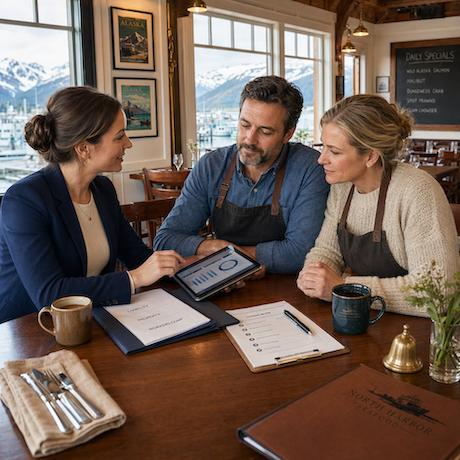
We know Fairbanks's restaurant scene block by block
Fairbanks' restaurant scene runs from a downtown that empties out fast once the mercury drops to a University of Alaska corridor that keeps a steady student and research-driven customer base all winter. Here's what we watch for across its neighborhoods.
Downtown Fairbanks / Cushman Street
Downtown Fairbanks restaurants see real, temperature-driven swings in walk-in foot traffic once nighttime lows drop into ice-fog territory, a distinctly different seasonal pattern from warmer-climate cities in this project worth building into staffing and delivery planning.
College Road / UAF Campus Area
Restaurants near the University of Alaska Fairbanks draw a steadier, less temperature-sensitive customer base tied to the academic calendar and research funding cycles, distinct from downtown's more weather-driven demand.
Core coverage lines every Fairbanks restaurant should evaluate
Restaurant insurance in Fairbanks is a tailored bundle built around Alaska law, local licensing, and your lease. Here's what actually protects Fairbanks food service businesses.
General Liability Insurance
Protects against third-party bodily injury and property damage claims. Responds when guests slip, suffer foodborne illness, or get injured during delivery. Most landlords require $1M/$2M before lease signing.
Commercial Property Insurance
Covers your kitchen equipment, refrigeration and HVAC, tenant improvements, inventory, and business personal property against fire, equipment breakdown, and theft.
Business Owner's Policy (BOP)
Bundles general liability, commercial property, and business interruption into one package. Works best for single-unit restaurants with annual revenue under $3 million.
Liquor Liability Insurance
Alaska Statute 04.21.020 grants general civil immunity to alcohol providers, but a licensee or its employee loses that protection for serving alcohol to a minor without checking valid ID or to a person who is visibly drunk, a real exception the Alaska Supreme Court enforced in Kavorkian v. Tommy's Elbow Room, Inc. (1985). Standard general liability policies exclude alcohol-related claims regardless of the immunity question. Standalone liquor liability coverage is still essential, not optional, for any Alaska establishment that serves alcohol.
Workers' Compensation Insurance
The Alaska Workers' Compensation Act (AS 23.30) requires coverage from your very first employee, full time, part time, or seasonal, with no minimum-hours exception, for-profit or nonprofit. Alaska has no state fund, so coverage comes through the private commercial market, or through the state's Assigned Risk Pool if no carrier will write it. Sole proprietors, partners, and 10%-plus owners are automatically exempt from covering themselves. Alaska has no reciprocity with any other state, so even an out-of-state employee working in Alaska needs Alaska-admitted coverage. Operating without required coverage risks direct civil liability for the full value of a claim.
Business Interruption Insurance
Replaces lost income and covers ongoing expenses when covered events force shutdowns or reduced capacity. Limits should reflect 3 to 6 months of net income plus fixed expenses.
What restaurant insurance typically costs in Fairbanks
A rough range based on real Alaska market data. Not a quote, just a starting point before you talk to an agent about your specific Fairbanks location.
| Coverage | Typical Range | Why |
|---|---|---|
| General Liability Insurance | $520-$1,500/yr | Alaska doesn't legally require general liability coverage, but Fairbanks' commercial landlords and liquor licensing commonly make it a condition of occupancy anyway. |
| Liquor Liability Insurance | $1,000-$3,500/yr | AS 04.21.020's general immunity for alcohol servers doesn't cover serving a minor or a visibly drunken patron, a real, defined exception the Alaska Supreme Court has enforced, making standalone coverage a real need rather than a formality. |
| Commercial Property w/ Extreme Cold & Pipe-Freeze Review | $2,200-$7,000/yr | Fairbanks' subarctic winters and its documented all-time record low of -66°F are two separate, real reasons to confirm your property policy's frozen-pipe and heating-system-failure terms before the coldest stretch of the year, not after. |
| Workers' Compensation (mandatory from your first hire) | $60-$230+/month per policy | A private carrier, not a state fund, is the only source for this coverage in Alaska, and Fairbanks restaurants have no exception for the seasonal swing between UAF's academic year and summer, coverage has to be active before a single student's first shift, part-time or not. |
| Business Owner's Policy (BOP), Bundled | $1,400-$4,200/yr | Bundles general liability and commercial property at a discounted rate, the standard starting point for most single-unit Fairbanks cafes and casual-dining concepts. |
| Full-Service, High-Volume, Bundled | $6,800-$11,000+/yr | Downtown full-bar restaurants with 15+ staff should budget toward this range, reflecting both alcohol-service volume and Fairbanks' extreme-cold property risk. |
Why Fairbanks' extreme cold and Alaska's private-market workers' comp change what your policy needs to do
Fairbanks restaurant coverage has to account for a documented, recurring cold-weather risk that goes well beyond a typical winter, layered against a state legal framework where there's no state fund backstop for workers' comp.
Fairbanks' cold isn't just uncomfortable, it's a documented structural and operational risk
Fairbanks sits in an actual subarctic climate zone where daily lows commonly run -20°F to -25°F through the heart of winter, and the city's all-time record low, -66°F, was set in January 1934. Below roughly -30°F, with the right humidity and a strong temperature inversion, Fairbanks experiences ice fog, a thick, blinding ground fog formed from vehicle exhaust and heating-system water vapor freezing in place instead of dispersing, a real visibility and delivery-logistics hazard on top of the cold itself. For a Fairbanks restaurant, that combination means frozen pipes, heating-system failures, and walk-in cooler malfunctions from the cold outside the building are a recurring, foreseeable risk, not a rare emergency, worth confirming your commercial property policy actually covers rather than assuming a standard policy handles it the same way it would in a milder climate.
Alaska's private workers' comp market means there's no state fund safety net
Unlike North Dakota, Ohio, Washington, or Wyoming, Alaska runs no state workers' comp fund at all. A Fairbanks restaurant has to secure coverage through the ordinary private commercial insurance market, and if no carrier will write the policy, the only fallback is Alaska's Assigned Risk Pool, administered through the National Council on Compensation Insurance. Because Alaska also has no reciprocity agreements with any other state, this applies just as fully to a University of Alaska Fairbanks student hired for a single semester as it does to a year-round employee, with no minimum-hours carve-out.
A hard cold snap drops Fairbanks below -30°F overnight, freezing a downtown restaurant's kitchen pipes before the morning shift arrives.
A closer look at how Fairbanks's documented risk factors actually play out.
A hard cold snap drops Fairbanks below -30°F overnight, freezing a downtown restaurant's kitchen pipes before the morning shift arrives.
- The setup: A downtown Fairbanks restaurant relies on its heating system running continuously through the night without a documented failure plan for extreme cold.
- The direct impact: A sudden hard cold snap below -30°F, the same threshold that triggers Fairbanks' ice fog, causes a heating failure overnight, and kitchen pipes freeze and burst before staff arrive for the morning shift, flooding part of the kitchen and damaging equipment.
- The coverage question: Confirm your commercial property policy's actual frozen-pipe and equipment-breakdown terms, and check whether it requires documented preventive measures like heat tracing or a minimum indoor temperature to remain valid.
- The fix: Building extreme-cold-specific coverage confirmation into a Fairbanks restaurant's annual policy review, not treating a hard freeze as a once-in-a-decade surprise, is what keeps a truly foreseeable cold snap from becoming an uninsured loss.
This is exactly why Fairbanks-specific coverage matters. A generic statewide policy summary misses how much colder and more operationally disruptive this city's winters run compared to Alaska's coastal cities.
Frequently asked questions
How much does restaurant insurance cost in Fairbanks?
A comprehensive restaurant insurance package in Fairbanks typically runs $1,400 to $6,800 per year for most single-unit operators, with full-bar, high-volume restaurants running $6,800 to $11,000 or more. General liability runs roughly $520 to $1,500 per year; a bundled BOP runs $1,400 to $4,200 per year; liquor liability runs $1,000 to $3,500 per year, and commercial property with an extreme-cold review commonly runs $2,200 to $7,000 per year given Fairbanks' documented winter severity.
Is workers' compensation required for a small Fairbanks restaurant?
Yes, and it applies just as fully to a University of Alaska Fairbanks student working a single semester as it does to a year-round line cook, with no minimum-hours exception. Because Alaska has no state fund, that coverage has to be purchased on the private market, or through the state's Assigned Risk Pool if the open market declines the risk.
Can a Fairbanks bar be sued for over-serving a customer?
Yes, in a specific, real circumstance. Alaska Statute 04.21.020's general immunity for alcohol servers doesn't extend to a licensee who serves a minor without checking valid ID or serves someone who's visibly drunk, the same exception the Alaska Supreme Court enforced against a bar in Kavorkian v. Tommy's Elbow Room, Inc., which is why a Fairbanks bar should still carry standalone liquor liability coverage rather than rely on the statute's general immunity alone.
Does Fairbanks' extreme cold still matter for restaurant insurance today?
It matters directly for property coverage, not just as background context. With winter lows regularly running -20°F to -25°F and a documented all-time record of -66°F, frozen pipes and heating-system failures are a recurring, foreseeable Fairbanks risk, and a restaurant owner should confirm their commercial property policy's actual terms for cold-weather equipment failure rather than assume standard coverage handles it the same way it would in a milder climate.
What kind of insurance does a Fairbanks restaurant actually need?
The core package is general liability, commercial property, and liquor liability if you serve alcohol, often bundled into a Business Owner's Policy for savings. Workers' compensation is legally required from your very first employee and has to be purchased on the private market since Alaska has no state fund, and Fairbanks restaurants specifically should confirm their property coverage addresses extreme-cold equipment failure and frozen-pipe risk.
Get Fairbanks restaurant coverage built around your actual neighborhood and real local risk.
Tell us your concept and your Fairbanks neighborhood. We'll put together the coverage that actually applies.
Get Your Free Quote →