




Restaurant Insurance in Chapel Hill, North Carolina
Chapel Hill's most recent federal declaration came in July 2025 from a tropical depression, which is a useful corrective: the system does not have to be a hurricane to close your kitchen. Two local rules are unusually consequential here. No alcohol permit may be issued to a business on the campus or property of a public university except through a short list of exceptions, and an employee's intoxication stops barring a comp claim the moment the employer supplied the drink.
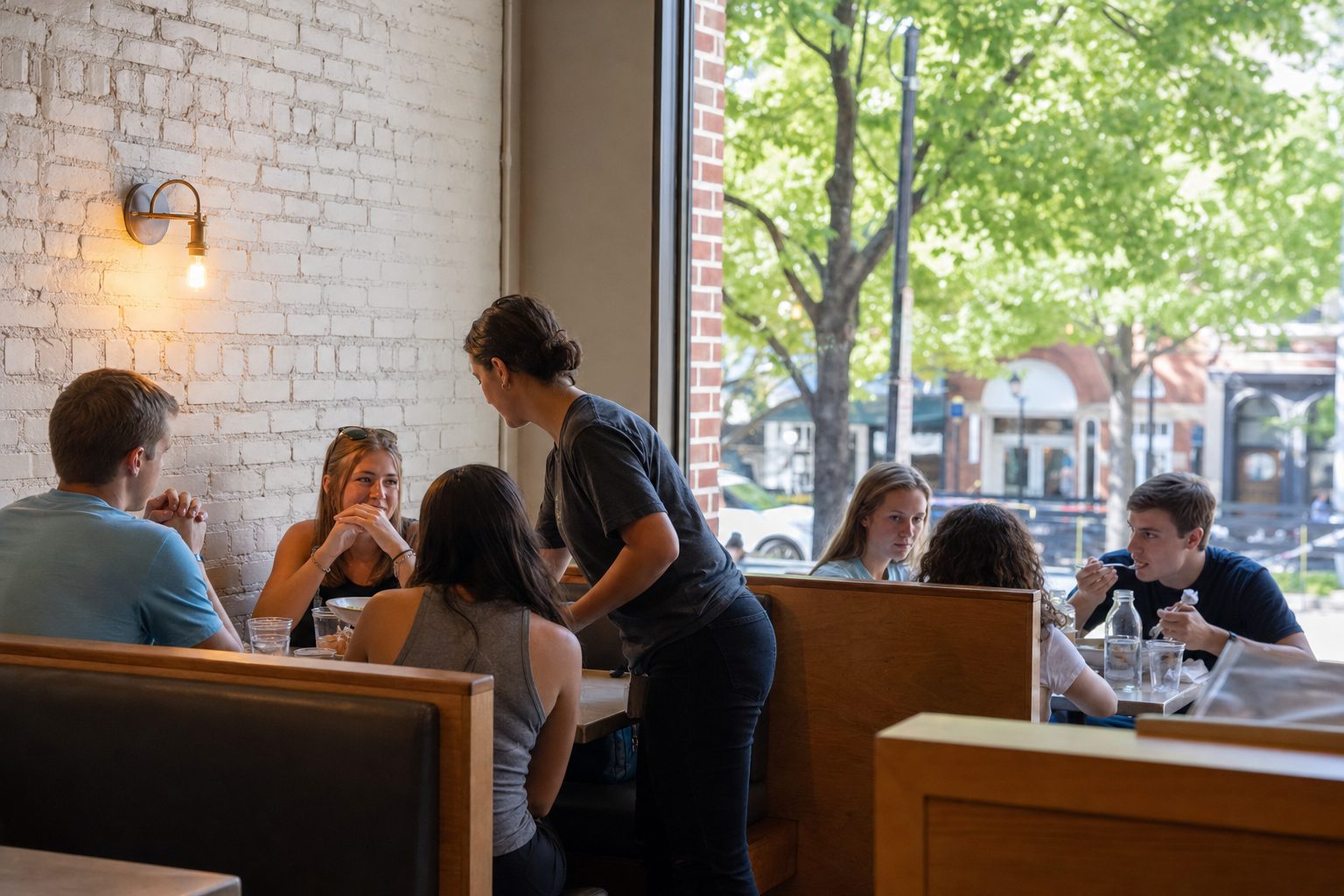
We know Chapel Hill's restaurant scene block by block
Chapel Hill packs a dense dining economy into a few blocks that sit alongside, and sometimes on, university land.
Franklin Street and the university edge
Blocks where the address decides the permit. Whether a site counts as university property is a licensing question before it is a lease question.
Kitchens and bars citywide
A trade where a drink at the end of service is common. In North Carolina that habit changes who carries the cost of an injury.
The creek corridors and low ground
Ground where a slow-moving depression does more damage than a fast hurricane, because the water simply keeps arriving.
Term time versus summer
A year with pronounced dead stretches. A July closure and a October closure are entirely different financial events.
Student-heavy rosters
Crews that change every term, which makes training records and safety rules harder to keep current and more important to have.
Core coverage lines every Chapel Hill restaurant should evaluate
A Chapel Hill policy has to handle slow water, a permit question tied to the property line, and a comp defense that hospitality routinely forfeits.
General Liability Insurance
Franklin Street carries heavy pedestrian traffic through long trading hours. This line stands behind guest injury and third-party property damage tied to the premises and your operations.
Commercial Property Insurance
A tropical depression is a rainfall event. The property form answers wind, so on low ground near the creeks the realistic loss sits outside it unless flood has been placed separately.
Business Owner's Policy (BOP)
A single Franklin Street room usually fits a business owner's policy, combining property and general liability below the cost of separate placements.
Liquor Liability Insurance
Your address may decide your permit. No permit for the sale of alcoholic beverages may be issued to a business on the campus or property of a public school, college or university, subject to a listed set of exceptions that includes a hotel, a nonprofit alumni organization, certain restaurants and retail on defined university property, and public golf courses.
Workers' Compensation Insurance
The intoxication defense has a hospitality-sized hole in it. Compensation is barred where injury was proximately caused by the employee's intoxication, but only where the intoxicant was not supplied by the employer or an agent in a supervisory capacity.
Business Interruption Insurance
A closure in term time costs several times the same closure in July. Business interruption needs an indemnity period measured against the academic year.
What restaurant insurance typically costs in Chapel Hill
Chapel Hill prices close to the Piedmont norm with a student-driven trading profile. The numbers below are a planning range rather than a quote.
| Coverage Type | Typical Annual Range | Why It Varies in Chapel Hill |
|---|---|---|
| General Liability Insurance | $500-$1,750/yr | Pedestrian volume on Franklin Street and long trading hours drive this. |
| Commercial Property | $1,000-$3,800/yr | Answers wind rather than rainfall flooding; check what is stored at or below grade. |
| Flood (separate placement) | Separately rated | Placed on its own near the creek corridors, where a slow depression is the realistic loss. |
| Liquor Liability Insurance | $850-$2,900/yr | A young guest profile and student-heavy trade both feed the rating. |
| Workers' Compensation | Payroll-class rated | Required at three or more employees, and in hospitality the intoxication defense is routinely forfeited because the employer poured the drink itself. |
| Business Interruption, term-weighted | Rated by exposure | Sized against the semesters that carry the year rather than an even twelve months. |
| Full Program w/ Alcohol | $4,000-$9,000/yr | The upper end reflects late trading close to campus. |
Why the staff drink after close changes who pays for an injury
A drink at the end of service is ordinary in this trade and nobody thinks of it as a risk transfer. In North Carolina it is exactly that, because the statute that would otherwise bar a claim carries a condition most restaurants break every week.
The intoxication defense, and its condition
G.S. 97-12 provides that no compensation is payable where the injury or death was proximately caused by the employee's intoxication, "provided the intoxicant was not supplied by the employer or his agent in a supervisory capacity to the employee." The section defines intoxication as having consumed enough to lose normal control of bodily or mental faculties, to the extent of appreciable impairment at the time of injury, and puts the burden of proof on whoever claims the exemption or forfeiture.
No permit on public campus property
G.S. 18B-1006(a) provides that no permit for the sale of alcoholic beverages shall be issued to a business on the campus or property of a public school, college or university. The exceptions are listed and finite, and include a hotel, a nonprofit alumni organization, restaurants and retail businesses on property defined by G.S. 116-198.33(4), public golf courses owned or leased by the institution, and certain performing arts centers and stadiums for malt and wine sales.
How a shift drink turns a barred claim into a payable one
The statute looks like it protects the employer. The condition attached to it is written for exactly the situation a bar creates for itself.
A cook is hurt after the manager pours a round for the closing team
- The setting: Service ends, the manager pours drinks for the crew, and a cook is injured on the way out of the kitchen.
- The gap: Ordinarily G.S. 97-12 would bar compensation where intoxication proximately caused the injury. The proviso removes that bar where the intoxicant was supplied by the employer or by an agent in a supervisory capacity, which is precisely what a manager pouring for staff is.
- The fix: The house rule on staff drinking is written down and enforced rather than tolerated, supervisory staff understand that pouring for the team changes the legal position, and any after-hours practice is reviewed against what the policy assumes about the operation.
- The result: A defense that is still available, because nobody handed it away at the end of a shift.
The proviso was not drafted with restaurants in mind. It lands on them harder than on anyone else.
Frequently asked questions
How much does restaurant insurance cost in Chapel Hill, North Carolina?
A full-service Chapel Hill restaurant with alcohol commonly runs $4,000 to $9,000 a year across property, general liability, liquor liability and workers' compensation, with flood placed separately near the creek corridors. Trading hours and proximity to campus move it most.
Can a restaurant on university property get a liquor permit in North Carolina?
Only through a listed exception. G.S. 18B-1006(a) says no permit for the sale of alcoholic beverages shall be issued to a business on the campus or property of a public school, college or university, and then lists the exceptions, which include a hotel, a nonprofit alumni organization, restaurants and retail on property defined by G.S. 116-198.33(4), and public golf courses owned or leased by the institution.
Does an employee's drinking bar a workers' comp claim in North Carolina?
Usually, but not where you supplied the drink. G.S. 97-12 bars compensation where injury was proximately caused by the employee's intoxication, provided the intoxicant was not supplied by the employer or an agent in a supervisory capacity. A manager pouring for staff after service removes the bar.
Is a tropical depression covered like a hurricane?
The damage mechanism is usually different, which is what matters. Orange County was designated under DR-4889 for Tropical Depression Chantal over 6 to 7 July 2025, and a slow depression does its damage through rainfall rather than wind, which puts the loss on the flood side of the policy rather than the windstorm side.
How should a college-town restaurant set its indemnity period?
Against the academic year. A room fully repaired over the summer may still have missed nothing, while one closed through a semester has lost a disproportionate share of the year, so an indemnity period built on even monthly revenue understates it.
Do student employees count toward the three-employee threshold?
Yes. North Carolina counts people regularly employed in the business, with no student carve-out, so a term-time roster can put a restaurant over the threshold even if the summer roster does not.
Get Chapel Hill coverage that survives the shift drink and the slow storm.
Tell us whether your address touches university property, how your terms trade and what your house rule on staff drinking is. We'll build a program that keeps the defenses you are entitled to.
Get Your Free Quote →