




Restaurant Insurance in Santa Barbara, California
Santa Barbara restaurants carry an exposure most of California does not: a wildfire and debris-flow history that sits right on the line between what property policies cover and what they exclude. Add a seasonal tourist economy, a protected architectural style that raises rebuild costs, and a compact downtown bar corridor, and the pricing logic changes. Landlords generally expect $1 million per occurrence and $2 million aggregate general liability before you take possession.
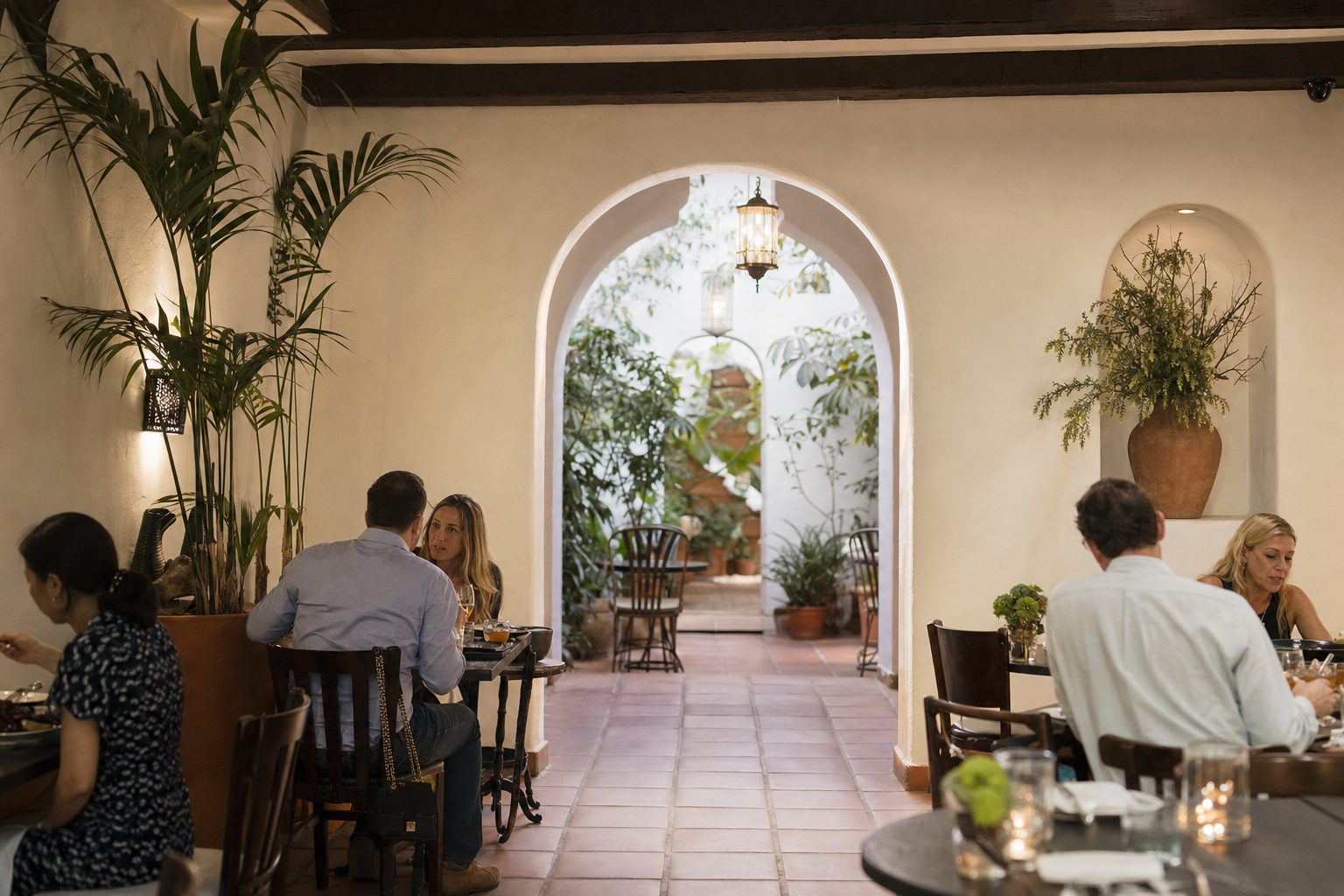
We know Santa Barbara's restaurant scene block by block
Santa Barbara's dining districts sit within a mile or two of each other and still carry quite different risks, because the hillside, the waterfront and the historic core each fail in their own way.
Montecito and Coast Village Road
Restaurants below the burn-scar hillsides that produced the January 2018 debris flow. Properties here face a sequence risk rather than a single peril, and the distinction between fire damage and earth movement decides whether a claim is paid.
Lower State Street
The city's concentrated bar strip, where closing-hour crowds move between venues in a few blocks. Carriers price this corridor on security staffing and hours, and assault-and-battery cover is routinely restricted.
Downtown and the Presidio area
Spanish colonial revival frontage subject to architectural review, where repairs and rebuilds have to match a protected style. Design requirements raise reconstruction costs well above a generic per-square-foot estimate.
Funk Zone
A dense block of tasting rooms, breweries and small kitchens in converted industrial buildings near the harbor. Mixed alcohol-led and food-led operations under one roof complicate how a policy classifies the business.
Waterfront and Stearns Wharf
Tourist-driven trade with payroll that doubles in summer and contracts sharply after. Swinging payroll makes accurate classification and honest reporting the difference between a clean audit and an expensive one.
Core coverage lines every Santa Barbara restaurant should evaluate
Santa Barbara restaurant insurance is assembled from separate coverages, and here the property side deserves the closest reading. The hillside history is the reason.
General Liability Insurance
Funk Zone tasting rooms and State Street sidewalk seating put guests on uneven surfaces and shared walkways. General liability answers third-party bodily injury and property damage connected to your premises and operations.
Commercial Property Insurance
Downtown's architectural review requirements mean a rebuild has to match a protected style, which costs more than an equivalent new build elsewhere. A limit set from floor area alone will not fund that reconstruction.
Business Owner's Policy (BOP)
A single Funk Zone kitchen or one Coast Village Road cafe generally fits a business owner's policy, packaging property and general liability more efficiently than buying the two separately.
Liquor Liability Insurance
Local rules sit on top of the state rule here rather than replacing it. ABC states that cities and counties may apply additional ordinances that further support the efforts of AB 1221 but cannot supersede the standards the act defines, so RBS certification stays mandatory for every Santa Barbara server whatever the city requires.
Workers' Compensation Insurance
An uninsured claim does not simply disappear. The Division of Workers' Compensation describes the Uninsured Employers' Benefit Trust Fund as a unit that may pay benefits to workers injured while employed by an illegally uninsured employer, and notes that it pursues reimbursement through all available avenues, including filing liens against the employer's property.
Business Interruption Insurance
A road closure, an evacuation order or a fire can stop trading in a tourist economy at exactly the point in the season when the revenue matters most. Business interruption replaces the income the location would have earned.
What restaurant insurance typically costs in Santa Barbara
The ranges below are typical for Santa Barbara rather than bindable. Wildfire scoring, building style requirements and alcohol mix are the main variables.
| Coverage Type | Typical Annual Range | Why It Varies in Santa Barbara |
|---|---|---|
| General Liability Insurance | $850-$2,500/yr | Higher on the lower State Street bar strip and at sites with sidewalk seating. |
| Commercial Property (wildfire-rated) | $3,200-$11,000/yr | Hillside and burn-scar proximity, plus architectural review rebuild costs, both push pricing up sharply. |
| Liquor Liability Insurance | $1,300-$4,400/yr | Driven by closing hour and alcohol share, with Funk Zone tasting-room classification a separate question. |
| Workers' Compensation | Payroll-class rated | Required from the first employee, with seasonal payroll swings making accurate reporting critical. |
| Small Cafe, Bundled | $5,000-$9,000/yr | A baseline for a smaller operation away from the highest wildfire scoring. |
| Full-Service w/ Alcohol, Bundled | $12,000-$26,000+/yr | The top of the range reflects hillside siting, protected architecture and late service. |
Why the Thomas Fire sequence still shapes Santa Barbara property cover
The 2017 and 2018 disaster sequence is not local history as far as an underwriter is concerned, it is the template for how losses happen here. A fire on the hillside removes the vegetation that holds the slope, and the next significant rain moves the slope. Those are two different perils under most property forms, and only one of them is usually covered.
The sequence, on the record
FEMA declared a major disaster for Ventura and Santa Barbara counties on January 2, 2018 for the Thomas Fire. One week later, on January 9, 2018, debris flows struck Montecito, killing 23 people, according to Santa Barbara County and Cal OES.
Why that matters on your policy
Fire is a named peril on essentially every commercial property form. Earth movement, including mudflow and debris flow, is commonly excluded. When one causes the other, the question of which peril actually caused the loss is where the argument happens, and it is worth settling in writing before a loss rather than after.
How burn-scar proximity changes a Coast Village Road quote
Being below a recent burn scar is a specific, mappable condition rather than a general wildfire worry, and it changes the questions worth asking.
You're taking a restaurant space on Coast Village Road, below the hills that burned
- The setting: Your building sits downslope of terrain that has burned within recent memory, in a corridor that experienced debris flow in January 2018.
- The gap: Your property policy almost certainly covers fire and almost certainly excludes earth movement. A post-fire debris flow can therefore produce a large loss that falls into the excluded half.
- The fix: The exclusion wording is read before binding, difference-in-conditions or a specific mudflow extension is priced where it is available, and your business interruption trigger is checked against evacuation and road closure as well as direct damage.
- The result: You know in advance which of the two likely scenarios your policy answers, instead of finding out in the middle of one.
This is the single most consequential coverage question in Santa Barbara, and it is routinely skipped on price-led quotes.
Frequently asked questions
How much does restaurant insurance cost in Santa Barbara, California?
A smaller Santa Barbara cafe commonly runs $5,000 to $9,000 a year bundled, while a full-service restaurant with alcohol typically falls between $12,000 and $26,000 or more. Wildfire scoring and architectural rebuild requirements drive the upper end.
Does my property policy cover mudslide or debris flow damage?
Usually not. Fire is a named peril on nearly every commercial property form, while earth movement, which generally includes mudflow and debris flow, is commonly excluded. Because a wildfire can set up the debris flow that follows it, the exact wording matters a great deal in Santa Barbara.
Does Santa Barbara have its own alcohol server training rules?
Whatever the city requires, the state requirement still applies. ABC states that cities and counties may apply additional ordinances that further support the efforts of AB 1221 but cannot supersede the standards defined in the act, so RBS certification remains mandatory.
What happens to an injured worker if I have no workers' comp?
The Division of Workers' Compensation describes the Uninsured Employers' Benefit Trust Fund as a unit that may pay benefits to workers hurt while working for an illegally uninsured employer, and states that it pursues reimbursement from the responsible employer through all available avenues, including filing liens against their property.
Why does architectural review affect my insurance?
Downtown rebuilds have to match a protected Spanish colonial revival style, which costs more per square foot than ordinary reconstruction. A limit set without accounting for that requirement will not fund the rebuild the city will actually require.
Is a Funk Zone tasting room classified as a restaurant?
Not automatically. A tasting room is an on-premises licensee and its staff need RBS certification, but how a carrier classifies the business for liquor liability depends on the alcohol share of revenue and whether a full kitchen operates. It is worth confirming before binding.
Get Santa Barbara restaurant coverage that reads the hillside, not just the balance sheet.
Tell us the address, the concept and your season. We'll build a Santa Barbara program around the perils that actually threaten this market, starting with the ones your policy may exclude.
Get Your Free Quote →