




Restaurant Insurance in Anchorage, Alaska
If you're an Anchorage restaurant owner searching for insurance that actually understands a city still shaped by the most powerful earthquake ever recorded in North America, a steady military and government customer base anchored by Joint Base Elmendorf-Richardson, and a state where workers' comp has to come from the private market with no state fund to fall back on, Insurance Kitchen builds coverage around that reality. We build Anchorage restaurant coverage around your actual neighborhood and real local risk.
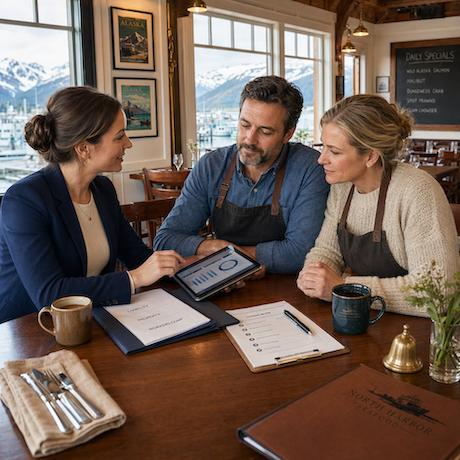
We know Anchorage's restaurant scene block by block
Anchorage's restaurant scene runs from a rebuilt downtown that still carries the memory of 1964 in its street layout to a military and government-anchored dining market that holds steady no matter the season. Here's what we watch for across its neighborhoods.
Downtown Anchorage / 4th Avenue
Downtown Anchorage was substantially rebuilt after the 1964 earthquake razed more than 30 blocks, and restaurants operating there today sit on ground the city itself has spent decades reinforcing, a real reason to confirm your property policy's earthquake and seismic-retrofit terms rather than assume standard coverage applies automatically.
Muldoon / JBER Gate Area
Restaurants near Joint Base Elmendorf-Richardson draw a steadier, less tourist-driven customer base tied to active-duty and government payroll cycles, a genuinely different demand pattern worth reflecting in staffing plans than Anchorage's more seasonal tourism-anchored districts.
Core coverage lines every Anchorage restaurant should evaluate
Restaurant insurance in Anchorage is a tailored bundle built around Alaska law, local licensing, and your lease. Here's what actually protects Anchorage food service businesses.
General Liability Insurance
Protects against third-party bodily injury and property damage claims. Responds when guests slip, suffer foodborne illness, or get injured during delivery. Most landlords require $1M/$2M before lease signing.
Commercial Property Insurance
Covers your kitchen equipment, refrigeration and HVAC, tenant improvements, inventory, and business personal property against fire, equipment breakdown, and theft.
Business Owner's Policy (BOP)
Bundles general liability, commercial property, and business interruption into one package. Works best for single-unit restaurants with annual revenue under $3 million.
Liquor Liability Insurance
Alaska Statute 04.21.020 grants general civil immunity to alcohol providers, but a licensee or its employee loses that protection for serving alcohol to a minor without checking valid ID or to a person who is visibly drunk, a real exception the Alaska Supreme Court enforced in Kavorkian v. Tommy's Elbow Room, Inc. (1985). Standard general liability policies exclude alcohol-related claims regardless of the immunity question. Standalone liquor liability coverage is still essential, not optional, for any Alaska establishment that serves alcohol.
Workers' Compensation Insurance
The Alaska Workers' Compensation Act (AS 23.30) requires coverage from your very first employee, full time, part time, or seasonal, with no minimum-hours exception, for-profit or nonprofit. Alaska has no state fund, so coverage comes through the private commercial market, or through the state's Assigned Risk Pool if no carrier will write it. Sole proprietors, partners, and 10%-plus owners are automatically exempt from covering themselves. Alaska has no reciprocity with any other state, so even an out-of-state employee working in Alaska needs Alaska-admitted coverage. Operating without required coverage risks direct civil liability for the full value of a claim.
Business Interruption Insurance
Replaces lost income and covers ongoing expenses when covered events force shutdowns or reduced capacity. Limits should reflect 3 to 6 months of net income plus fixed expenses.
What restaurant insurance typically costs in Anchorage
A rough range based on real Alaska market data. Not a quote, just a starting point before you talk to an agent about your specific Anchorage location.
| Coverage | Typical Range | Why |
|---|---|---|
| General Liability Insurance | $540-$1,600/yr | Alaska doesn't legally require general liability coverage, but Anchorage's commercial landlords and liquor licensing commonly make it a condition of occupancy anyway. |
| Liquor Liability Insurance | $1,200-$4,000/yr | AS 04.21.020 grants alcohol servers general immunity, but a licensee loses that protection for serving a minor or a visibly drunken patron, exactly the exposure standard general liability policies exclude, which is why standalone coverage is worth carrying rather than skipping. |
| Commercial Property w/ Seismic & Winter Review | $2,500-$8,500/yr | Anchorage's real earthquake exposure and its heavy winter snow load are two separate, documented reasons to confirm your policy's seismic and freeze-damage terms before renewing, not after a claim. |
| Workers' Compensation (mandatory from your first hire) | $65-$250+/month per policy | Alaska has no state fund, so an Anchorage restaurant buys this coverage on the open private market or, if declined there, through the state's Assigned Risk Pool, and it applies from your very first employee with no part-time exception. |
| Business Owner's Policy (BOP), Bundled | $1,500-$4,500/yr | Bundles general liability and commercial property at a discounted rate, the standard starting point for most single-unit Anchorage cafes and fast-casual concepts. |
| Full-Service, High-Volume, Bundled | $7,500-$12,000+/yr | Downtown and Midtown full-bar restaurants with 15+ staff should budget toward this range, reflecting both alcohol-service volume and Anchorage's seismic and winter property risk. |
Why Anchorage's earthquake history and Alaska's private-market workers' comp change what your policy needs to do
Anchorage restaurant coverage has to account for a documented, real seismic event that reshaped downtown itself, layered against a state legal framework where there's no state fund backstop for workers' comp.
The 1964 Good Friday earthquake set a real, documented benchmark for Anchorage's seismic risk
At magnitude 9.2, the March 27, 1964 earthquake remains the most powerful ever recorded in North America and the second most powerful ever recorded anywhere in the world, shaking for roughly 4.5 minutes. It killed 131 people total, damaged or destroyed more than 30 blocks of downtown Anchorage, dropped a downtown street more than 10 feet, and triggered a landslide in Turnagain Heights that carried 130 acres of land as much as 2,000 feet, destroying 75 homes. Restaurants operating in the rebuilt downtown core today sit on ground the city has actively reinforced for six decades since, which is exactly why confirming your commercial property policy's actual earthquake and seismic terms, rather than assuming standard coverage applies, is worth doing before you need it, not after.
Alaska's private workers' comp market means there's no state fund safety net
Unlike North Dakota, Ohio, Washington, or Wyoming, Alaska runs no state workers' comp fund at all. An Anchorage restaurant has to secure coverage through the ordinary private commercial insurance market, and if no carrier will write the policy, the only fallback is Alaska's Assigned Risk Pool, administered through the National Council on Compensation Insurance. Because Alaska also has no reciprocity agreements with any other state, an owner bringing in even one out-of-state employee for a busy season needs Alaska-specific, Alaska-admitted coverage in place regardless of what that worker's home-state policy already covers, making early planning with a broker who understands the Alaska market genuinely worth the lead time.
A heavy winter snow load strains an aging downtown Anchorage building's roof mid-service, and cracks appear in a wall the city reinforced decades ago.
A closer look at how Anchorage's documented risk factors actually play out.
A heavy winter snow load strains an aging downtown Anchorage building's roof mid-service, and cracks appear in a wall the city reinforced decades ago.
- The setup: A downtown Anchorage restaurant owner assumes decades-old seismic reinforcement means the building's structural risk is fully behind it.
- The direct impact: A heavy snow season adds real structural load on top of ground that already carries a documented seismic history, and visible cracking forces a mid-service evacuation and an emergency structural inspection.
- The coverage question: Confirm your commercial property policy's actual terms for both snow-load structural damage and any pre-existing seismic-related weakness, since a gap between the two can leave a claim only partially covered.
- The fix: Treating Anchorage's combined seismic and winter-load risk as one ongoing structural conversation with your insurer, not two separate boxes to check once, is what keeps a bad winter from becoming an uninsured structural claim.
This is exactly why Anchorage-specific coverage matters. A generic statewide policy summary misses how directly this city's seismic history and its winter property risk actually intersect.
Frequently asked questions
How much does restaurant insurance cost in Anchorage?
A comprehensive restaurant insurance package in Anchorage typically runs $1,500 to $7,500 per year for most single-unit operators, with full-bar, high-volume restaurants running $7,500 to $12,000 or more. General liability runs roughly $540 to $1,600 per year; a bundled BOP runs $1,500 to $4,500 per year; liquor liability runs $1,200 to $4,000 per year, and commercial property with a seismic and winter review commonly runs $2,500 to $8,500 per year given Anchorage's earthquake and snow-load exposure.
Is workers' compensation required for a small Anchorage restaurant?
Yes. Alaska sets no headcount or hours threshold, so hiring one part-time server puts an Anchorage restaurant on the hook starting that same shift. Since there's no state fund, the policy itself comes from an admitted private carrier or, failing that, Alaska's Assigned Risk Pool, and a business owner relocating staff from another state should know Alaska recognizes no other state's coverage as a substitute.
Can an Anchorage bar be sued for over-serving a customer?
Yes, in a real, defined circumstance. Alaska Statute 04.21.020 grants general immunity to alcohol providers, but a licensee loses that protection for serving a minor without checking valid ID or for serving a person who's visibly drunk, exactly the standard the Alaska Supreme Court applied against a bar in Kavorkian v. Tommy's Elbow Room, Inc. That's why an Anchorage restaurant serving alcohol should still carry standalone liquor liability coverage rather than assume the statute's general immunity removes the risk.
Does the 1964 earthquake still matter for restaurant insurance in Anchorage today?
It matters for how seriously commercial property coverage should be evaluated, not as a standalone insurance line. The Good Friday earthquake remains the most powerful ever recorded in North America, and downtown Anchorage's rebuilt infrastructure reflects six decades of seismic reinforcement work, which is why confirming your property policy actually covers earthquake and structural risk, not just fire and theft, is a specific, well-documented Anchorage need.
What kind of insurance does an Anchorage restaurant actually need?
The core package is general liability, commercial property, and liquor liability if you serve alcohol, often bundled into a Business Owner's Policy for savings. Workers' compensation is legally required from your very first employee and has to be purchased on the private market since Alaska has no state fund, and Anchorage restaurants specifically should confirm their property coverage addresses both seismic and heavy winter snow-load risk.
Get Anchorage restaurant coverage built around your actual neighborhood and real local risk.
Tell us your concept and your Anchorage neighborhood. We'll put together the coverage that actually applies.
Get Your Free Quote →