One Claim Can Close A Restaurant. Don't Let That Be Yours.
Access Tailored Restaurant Insurance in New Mexico
100%
Restaurant-Only Focus
12+
Carrier Markets
NM
Licensed Agents
Our Top A+ Rated Restaurant Insurance Carriers
Every carrier in our restaurant program holds an A+ rating from AM Best. We work with national carriers who write restaurant policies at volume, which means your coverage comes with the claims infrastructure, underwriting depth, and policy language that general business insurers do not offer. Our role is to match your specific concept, size, and risk profile to the carrier whose appetite fits, not just whoever has the lowest opening premium.
COVERAGE AREAS
What Makes New Mexico Restaurant Insurance Different
First, its dram shop statute under NMSA § 41-11-1 creates liability for licensed vendors when intoxication is reasonably apparent, and the New Mexico Supreme Court’s 1988 decision in Richardson v. Carnegie Library Restaurant, Inc. struck all statutory damage caps as unconstitutional under the state Equal Protection Clause. The result is unlimited dram shop liability with no ceiling — a risk profile more severe than Montana’s $250,000 cap, Nevada’s near-total immunity, or New Hampshire’s reckless standard with its responsible business practices defense.
Second, New Mexico’s wildfire insurance market has collapsed in ways now affecting restaurant operators directly: the state FAIR Plan doubled its commercial coverage limit to $2 million in October 2025, more than 6,200 commercial policies were non-renewed in 2025 alone, and the state now ranks second nationally for uninsured properties at 13 percent. Restaurants near the burn scars of the Hermits Peak-Calf Canyon and South Fork fires face the most acute market access problems.
General liability covers third-party bodily injury and property damage claims.
New Mexico restaurants face slip-and-fall exposure year-round from monsoon season rain on wet entryways and spilled food and beverage surfaces. Santa Fe and Taos restaurants serving significant tourist populations face elevated claim frequency during peak visitor seasons. Foodborne illness claims run through general liability, and New Mexico’s allergen poster requirement creates a disclosure compliance structure whose failures can affect liability defenses. Standard minimums run $1 million per occurrence and $2 million aggregate. Restaurants with full bar service should carry umbrella coverage above the general liability floor given unlimited dram shop exposure after Richardson.
Commercial property insurance covers the restaurant building, equipment, inventory, and furnishings against fire, wind, theft, and vandalism.
New Mexico’s primary property risk is wildfire and the market disruption that follows it. Restaurants in the northern highlands, the Jemez Mountains, and communities near recent burn scars face the most severe standard market access problems, with carriers non-renewing policies and replacement coverage available primarily through the FAIR Plan at significantly higher premiums. Operators in high-exposure zones should verify whether their policy includes wildfire as a named peril, confirm replacement cost values reflect current New Mexico construction costs, and review whether outdoor dining structures and signage are included in the property schedule.
New Mexico requires workers’ compensation coverage when a restaurant employs three or more workers, including part-time employees.
Restaurants with two employees must obtain coverage before the third hire, including seasonal additions during Santa Fe’s summer arts season or ski season in Taos and Red River. Kitchen burn injuries are the most frequent workers’ comp claim category for New Mexico restaurants, driven by grill, fryer, and oven exposure. Workers’ comp rates for New Mexico restaurant employees typically run $1.00 to $3.50 per $100 of payroll by classification.
New Mexico’s dram shop liability framework under NMSA § 41-11-1 imposes liability on licensed vendors when a person’s intoxication is reasonably apparent at the time of service and that person subsequently causes injury or death to a third party.
The Richardson decision removed the statutory damage cap, making New Mexico one of only a handful of states where a single dram shop judgment faces no ceiling. A catastrophic alcohol-related injury or fatality case can produce verdicts that exceed the assets of any single-location operation. Any restaurant holding an Alcohol Gaming Division license should carry liquor liability insurance with limits reviewed against the actual loss potential of an unlimited liability environment.
Commercial umbrella policies provide excess liability above underlying general liability, liquor liability, and auto limits.
The Richardson decision makes umbrella coverage a practical necessity for any New Mexico restaurant operating with full bar service. A primary liquor liability policy with $1 million limits may be adequate for most incidents, but an alcohol-related fatality in a state with unlimited dram shop damages can exhaust primary limits rapidly. Restaurants with high-volume bar operations in Santa Fe’s tourist market or Albuquerque’s dining district should review umbrella limits with the actual loss potential of an unlimited liability state in mind.
Crime coverage protects against employee theft, robbery, and check fraud.
New Mexico restaurants in tourist markets including Santa Fe’s Canyon Road corridor, the Taos Plaza, and Old Town Albuquerque handle elevated cash and card volumes during peak seasons. High seasonal transaction volumes in cash-intensive operations amplify the potential loss in any single theft event. Employee dishonesty coverage is typically included in BOP crime endorsements and is available as a standalone fidelity bond for operations requiring higher limits.
A Business Owner’s Policy bundles general liability, commercial property, and business interruption into a single contract at a combined premium typically lower than purchasing each separately.
Not every New Mexico operation qualifies, as carriers apply eligibility based on revenue, square footage, and operation type. Restaurants in the northern highlands, the Jemez Mountains, and communities near recent burn scars frequently fall outside standard BOP eligibility due to wildfire exposure, with some carriers declining to write property coverage in high-risk zones entirely. New Mexico operators should confirm their BOP’s property component addresses wildfire as a named peril and that replacement cost values reflect current construction costs in post-fire rebuild markets. A BOP does not replace workers’ compensation, liquor liability, or commercial auto. It is a foundation, not a finished program.
Santa Fe and Taos restaurants serving significant tourist populations process elevated payment card transaction volumes during peak seasons.
Point-of-sale data breaches expose operators to PCI DSS fines, cardholder notification costs, and forensic investigation expenses. New Mexico’s Data Breach Notification Act requires notification to affected residents and the state attorney general when personal identifying information is compromised. Cyber liability coverage addresses notification, forensic investigation, and regulatory response costs for any operation running modern POS infrastructure with stored cardholder data.
Food spoilage coverage pays for perishable inventory losses from refrigeration failures or power outages.
New Mexico’s desert heat creates persistent refrigeration stress during summer months, and wildfire-related power outages in affected areas can last multiple days. Contamination coverage extends to foodborne illness incidents requiring professional sanitation and temporary closure. Restaurants under the NMED Food Safety Program’s risk-based inspection schedule should maintain current compliance documentation, as inspection findings can affect the insurer’s handling of contamination claims.
Equipment breakdown coverage pays for sudden mechanical or electrical failure of commercial kitchen equipment excluded from standard property policies.
New Mexico’s desert heat drives HVAC failure, compressor burnout in refrigeration systems, and accelerated wear on cooking equipment operating in high-ambient-temperature environments. Restaurants in Santa Fe’s high-altitude climate face temperature differential stress distinct from desert valley conditions in Albuquerque and Las Cruces. Equipment breakdown coverage typically includes lost business income from equipment-caused closures, overlapping with business interruption for covered breakdown events.
Business interruption coverage replaces lost revenue when a covered event forces a closure.
New Mexico’s primary triggers are wildfire-forced evacuations, extended power outages, and municipal water disruptions that prevent food preparation. Santa Fe and Taos restaurants face significant tourism revenue concentration, with peak summer and ski seasons generating a substantial share of annual revenue in compressed windows. Coverage should reflect peak-season revenue rather than annualized averages. Operators should confirm their policy includes utility service interruption coverage, which activates when an off-premises event forces closure without direct physical damage to the restaurant.
New Mexico’s four-jurisdiction minimum wage structure creates wage and hour EPLI exposure for multi-location operators.
Tip credit miscalculations, failure to make up the difference when tips do not meet the applicable minimum wage floor, and cross-jurisdiction payroll configuration errors all generate wage claims. New Mexico’s active Human Rights Commission prohibits discrimination on grounds including sexual orientation and gender identity. EPLI covers wrongful termination, harassment, discrimination, and wage and hour defense costs for New Mexico restaurant operators.
WHO WE SERVE
New Mexico Restaurant Types We Serve
🍽️
Full-service New Mexico restaurants carry general liability, liquor liability under NMSA § 41-11-1 with limits reflecting unlimited post-Richardson exposure, workers’ comp from the third employee, commercial property with wildfire risk reviewed against current market conditions, and business interruption sized to seasonal revenue peaks. Umbrella coverage above liquor liability is essential for full bar operations. Server training documentation should be maintained as a written record for every alcohol service employee.
🥡
Fast casual operations typically have no liquor exposure but face general liability, workers’ comp at the three-employee threshold, the nine-allergen poster requirement, and the applicable minimum wage floor at their location. Equipment breakdown is important for high-volume refrigeration and cooking lines. Restaurants in Albuquerque must obtain food safety licensing through the City of Albuquerque Environmental Health Department rather than the NMED program.
🚚
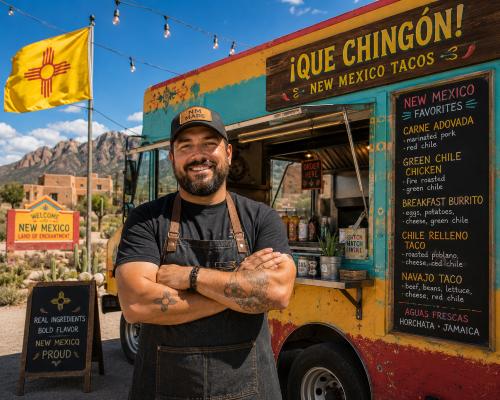
New Mexico food trucks need commercial auto for the vehicle, general liability, and product liability for every item sold. Workers’ comp applies from the third employee. NMED Food Safety Program licensing applies to mobile food units operating outside Bernalillo County; units operating in Albuquerque are subject to city licensing. The nine-allergen poster must be posted in a customer-visible location in the food truck service area.
🍱
New Mexico caterers face product liability and food contamination risk on every event. Catering-specific coverage addresses off-premises liability, hired-and-non-owned auto, and event cancellation. Caterers with alcohol service permits under the Alcohol Gaming Division carry NMSA § 41-11-1 unlimited dram shop exposure and should carry liquor liability coverage for any event at which alcohol is served. Server training completion within 30 days applies to catering staff who serve alcohol.
☕
New Mexico cafes with no alcohol service focus on general liability, commercial property with heat and wildfire exposure reviewed, equipment breakdown for espresso machines and refrigeration, and food spoilage. The allergen poster must be in customer sight. Cafes in Albuquerque are subject to city food safety licensing rather than NMED. The applicable minimum wage floor depends on the municipality of operation.
🍕
Pizzerias combine delivery auto risk, burn injury workers’ comp, and general liability. Commercial auto or hired-and-non-owned auto covers delivery drivers operating in New Mexico’s summer heat and monsoon conditions. Workers’ comp applies from the third employee, including part-time delivery drivers. Pizzerias with beer and wine service carry NMSA § 41-11-1 exposure and should maintain server training records.
🥂
New Mexico fine dining restaurants carry full bar service and the full unlimited dram shop liability profile. Santa Fe and Taos fine dining operations serve high-income tourist markets with elevated transaction volumes and higher average spend per table, which increases both the liquor liability exposure and the commercial property value. High-value wine inventory should be scheduled under the property policy with specific valuation. Equipment breakdown for specialized kitchen equipment is important in older adobe and historic building stock common to Santa Fe’s dining district.
👻
New Mexico ghost kitchens retain product liability for every delivered order and need commercial property with heat and wildfire exposure reviewed. Workers’ comp applies from the third employee. NMED or city food safety licensing is required based on location. The allergen poster requirement applies to ghost kitchen facilities even without a traditional front-of-house customer area; operators should confirm the local authority’s interpretation of the customer-visible placement requirement.
🥐
New Mexico bakeries face product liability for allergen disclosure failures — particularly relevant given the state’s nine-allergen poster mandate — workers’ comp for burn and repetitive motion injuries, and commercial property coverage for ovens and equipment in desert heat conditions. Equipment breakdown for commercial mixers and deck ovens is important. Operators selling at Santa Fe’s Farmers Market or tourist-area outdoor markets need off-premises general liability coverage for those events.
🏢
New Mexico franchise operators must meet franchisor insurance specifications while layering in state-specific requirements. Unlimited dram shop exposure after Richardson, the FAIR Plan wildfire property market, the four-jurisdiction minimum wage structure, and the three-employee workers’ comp threshold are all New Mexico-specific factors that standard franchise insurance templates may not address. Operators should review the franchise agreement’s insurance exhibit with their broker against New Mexico’s regulatory environment.
🗂️
New Mexico restaurant groups operating across Santa Fe, Albuquerque, Las Cruces, and Taos face four different minimum wage and tipped employee floors, two different food safety inspection authorities (NMED and the City of Albuquerque), and a FAIR Plan wildfire market that affects some locations more acutely than others. A master commercial policy with scheduled locations, business interruption limits calibrated by location, and umbrella coverage applied uniformly across all locations is the most efficient structure for multi-location operators.
New Mexico-Specific Risk Factors
NMSA § 41-11-1 and Richardson: Unlimited Dram Shop Damages:
New Mexico’s dram shop statute at NMSA § 41-11-1 creates liability for licensed vendors who serve alcohol when a patron’s intoxication is reasonably apparent. The statute was originally enacted with damage caps of $50,000 per person and $100,000 per occurrence for bodily injury. In Richardson v. Carnegie Library Restaurant, Inc. (1988), the New Mexico Supreme Court struck all three caps as unconstitutional under the New Mexico Equal Protection Clause. The practical result is unlimited civil exposure when an over-served patron causes injury or death. Verdicts in alcohol-related fatality cases in uncapped states routinely exceed the insurance limits carried by small and mid-sized restaurant operators. Restaurants with full bar service should size liquor liability limits to reflect the actual catastrophic loss potential in their market and supplement with umbrella coverage above the primary policy.
The New Mexico FAIR Plan Wildfire Crisis:
New Mexico’s standard commercial property market has been significantly disrupted by wildfire risk. The Hermits Peak-Calf Canyon fire complex in 2022 burned more than 340,000 acres, and the South Fork fire in 2024 added additional burn scar exposure. The top ten commercial insurers in New Mexico raised premiums 50 to 60 percent between 2022 and 2025, and non-renewals rose from approximately 1,900 in 2022 to more than 6,200 in 2025. The New Mexico FAIR Plan doubled its commercial property coverage limit from $1 million to $2 million in October 2025. Restaurants in wildfire-exposed zones should work with an independent broker who has access to the surplus lines market and FAIR Plan placement, confirm coverage limits reflect current replacement cost, and verify that business interruption coverage addresses wildfire-forced evacuation and closure scenarios.
The Four-Jurisdiction Minimum Wage Structure:
New Mexico requires operators to identify and apply the correct minimum wage at each restaurant location independently. The state minimum wage is $12.00 per hour with a tipped base of $3.00 per hour. Santa Fe city law sets a $15.00 per hour minimum with a $3.00 tipped base. Santa Fe County raised its living wage ordinance to $15.40 per hour in March 2026 with a tipped floor of $4.62 per hour. Las Cruces maintains a $13.01 per hour minimum with a $5.20 tipped base. Multi-location operators must maintain separate payroll configurations for each jurisdiction. The wage gap between the state tipped base of $3.00 and Santa Fe County’s $4.62 floor represents a 54 percent difference in base wage obligation, and multi-jurisdictional operators are among the highest-frequency targets for tip credit calculation disputes.
Server Training and the $15 Cost Cap:
New Mexico law requires all alcohol servers at Alcohol Gaming Division-licensed establishments to complete state-approved server training within 30 days of hire, with the cost of required training capped at $15 per employee. Employers are responsible for ensuring completion within the 30-day window and maintaining completion records. The training covers recognition of intoxication, service refusal procedures, and New Mexico’s dram shop liability framework. Given the unlimited liability exposure under NMSA § 41-11-1 and Richardson, server training documentation is a factual element a defendant will need to present in any dram shop litigation. A restaurant that cannot demonstrate systematic compliance with the training mandate faces a harder liability defense when a patron’s intoxication is disputed.
Bernalillo County and Albuquerque’s Independent Food Safety Authority:
New Mexico’s food safety inspection and licensing is administered by the NMED Food Safety Program statewide on a risk-category basis. Bernalillo County and the City of Albuquerque operate outside the NMED system entirely, maintaining their own licensing programs, inspection schedules, and compliance standards. A restaurant opening in Albuquerque must apply through the City of Albuquerque Environmental Health Department, not NMED. A restaurant with locations in both Albuquerque and Santa Fe is simultaneously regulated by two different food safety authorities with different inspection triggers and license renewal calendars. Compliance gaps in the applicable authority’s licensing requirements can complicate a liability defense in a foodborne illness or product liability action.
The Nine-Allergen Poster Requirement:
New Mexico requires all food establishments to post an allergen awareness poster identifying the nine major food allergens in a location visible to customers. The nine allergens are milk, eggs, fish, shellfish, tree nuts, peanuts, wheat, soybeans, and sesame. Customer-visible placement is required, meaning front-of-house or counter posting. Operators cannot satisfy this requirement by posting only in kitchen or staff areas. Allergen poster failures that contribute to a customer allergic reaction create product liability exposure covered under general liability. Operators should also audit menu language for any express or implied allergen representations, as inconsistency between poster content and menu descriptions can create compounding liability in a serious allergen incident.
Alcohol Gaming Division Licensing and Annual June 30 Renewal:
New Mexico liquor licenses issued by the Alcohol Gaming Division expire on June 30 each year, creating a renewal cycle different from the month-of-issuance structures used in many states. All restaurants holding a beer and wine license, dispenser permit, or restaurant license must renew by June 30 or face license lapse. A lapsed alcohol license creates both a regulatory compliance problem and a potential liquor liability insurance issue, as some policies condition coverage on the insured’s maintenance of a valid license. Restaurant operators should integrate the June 30 renewal date into their annual compliance calendar and confirm their broker is aware of the date to coordinate policy renewal timing.
WHY INSURANCE KITCHEN
Why Restaurant Owners Choose Us
We specialize exclusively in food service operations. Every carrier we access, every policy we place, is built around restaurant risk — not adapted from a general commercial template.
We shop 12+ carriers to find the right match for your operation — not just the first carrier who will write the policy. Your coverage should reflect your specific risk profile.
Fast Turnaround
Most restaurants get coverage options within 24 – 48 hours. Opening soon, renewing, or replacing a policy that’s not working — we move fast because your timeline matters.
COMMON QUESTIONS
New Mexico Restaurant Insurance: Frequently Asked Questions
What is New Mexico's dram shop law for restaurants?
New Mexico’s dram shop liability statute at NMSA § 41-11-1 imposes liability on licensed vendors who serve alcohol when intoxication is reasonably apparent. The New Mexico Supreme Court struck all statutory damage caps as unconstitutional in Richardson v. Carnegie Library Restaurant (1988), creating unlimited dram shop liability exposure for restaurant operators. Any restaurant holding an Alcohol Gaming Division license should carry liquor liability insurance with limits reviewed against the actual catastrophic loss potential of an unlimited liability environment.
What is the FAIR Plan wildfire insurance situation for New Mexico restaurants?
New Mexico’s standard commercial property insurance market has been significantly disrupted by wildfire risk. The state FAIR Plan doubled its commercial coverage limit to $2 million in October 2025. Non-renewals rose from about 1,900 in 2022 to more than 6,200 in 2025. Premiums from the top ten insurers rose 50 to 60 percent since 2022. New Mexico now ranks second nationally for uninsured properties at 13 percent. Restaurants in wildfire-exposed areas should work with an independent broker with access to surplus lines markets and FAIR Plan placement.
What is New Mexico's minimum wage for restaurant workers?
New Mexico has a four-jurisdiction minimum wage structure. The state floor is $12.00 per hour ($3.00 tipped base). Santa Fe city is $15.00 per hour ($3.00 tipped). Santa Fe County is $15.40 per hour ($4.62 tipped, March 2026). Las Cruces is $13.01 per hour ($5.20 tipped). Albuquerque currently applies the state rate for tipped employees. Multi-location operators must apply the correct rate independently at each location.
Does New Mexico require workers' compensation for restaurants?
Yes, from the third employee. New Mexico requires workers’ compensation coverage when a restaurant employs three or more workers, including part-time employees. The coverage obligation activates before the third employee’s first day of work.
What food safety inspection authority applies to Albuquerque and Bernalillo County restaurants?
Albuquerque and Bernalillo County restaurants are not regulated by the state NMED Food Safety Program. They are regulated by the City of Albuquerque Environmental Health Department and Bernalillo County’s own food safety programs. Operators must contact the local authority for all licensing in these jurisdictions.
What is the server training requirement for New Mexico restaurant employees?
New Mexico requires alcohol servers at Alcohol Gaming Division-licensed establishments to complete state-approved training within 30 days of hire. The training cost is capped by law at $15 per employee. Completion records should be maintained as a written record for each employee.
What allergen disclosure is required for New Mexico restaurants?
New Mexico requires an allergen poster identifying nine major allergens — milk, eggs, fish, shellfish, tree nuts, peanuts, wheat, soybeans, and sesame — posted in a location visible to customers. Operators cannot satisfy the requirement by posting only in staff areas.
How much does restaurant insurance cost in New Mexico?
New Mexico restaurant insurance typically runs $3,000 to $10,000 per year for a core coverage package. The upper end reflects liquor liability limits appropriate for unlimited post-Richardson dram shop exposure and elevated commercial property premiums from the FAIR Plan wildfire market disruption. Restaurants in burn scar areas may face FAIR Plan placement at significantly higher premiums than standard market rates. The Insurance Kitchen builds comparative quotes for New Mexico operators addressing the full state-specific risk profile.
Get Your Restaurant Covered Today
Insurance Kitchen specializes exclusively in restaurants. No generalists, no boilerplate programs. Call (234) 271-4963 or start your custom quote online to build coverage calibrated to your operating environment.